
2026-7-30
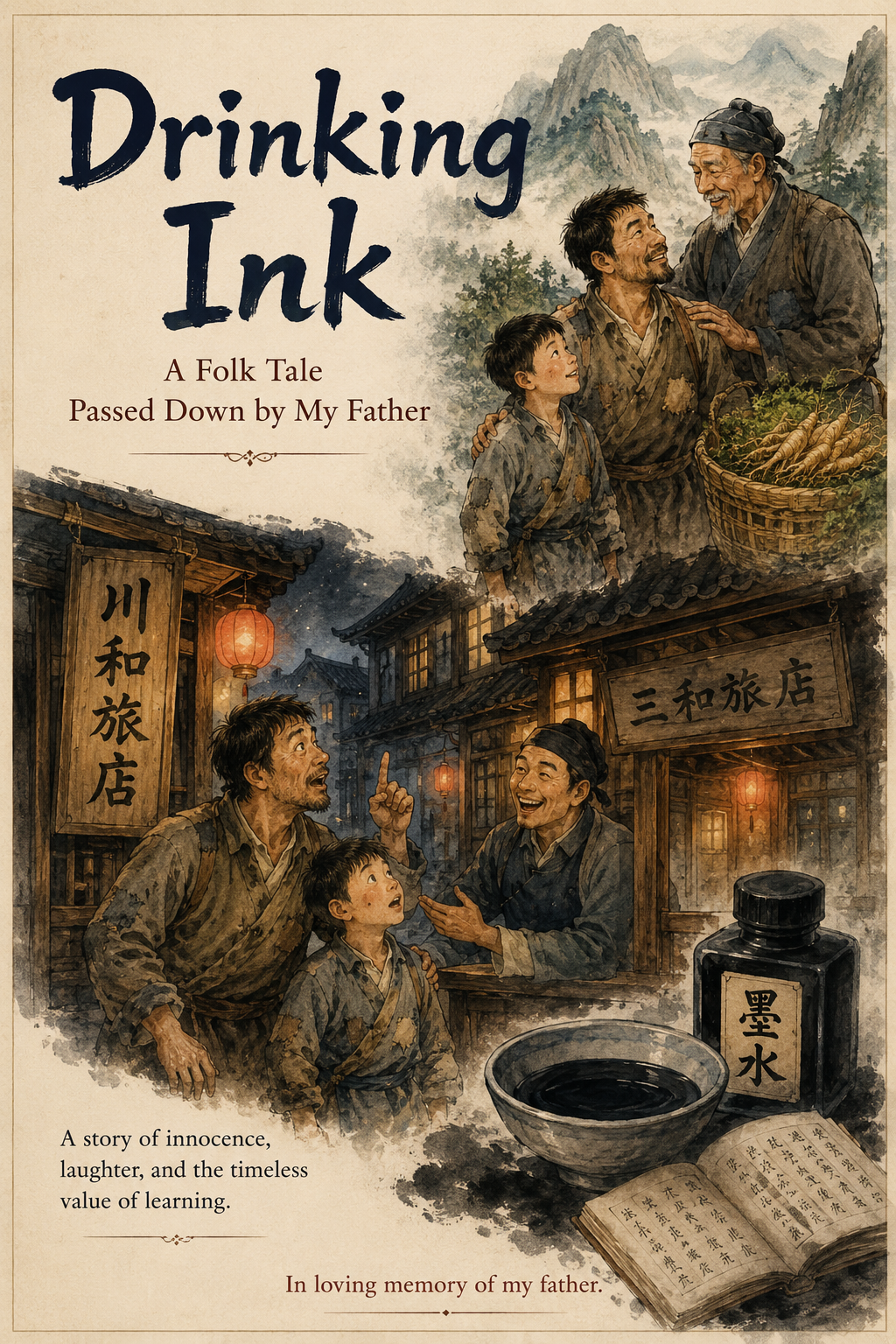
喝墨水
——根據父親講述的民間故事整理
文/泰華
深山裡,住著一對相依為命的父子。
父親早年喪妻,獨自帶著兒子,以進山採挖野生人參維生。父子倆年復一年,在深山裡風餐露宿,挖到的人參,全都賣給山下一位老商人。
靠著父子倆送來的人參,老商人的生意越做越大。到了晚年,他決定收山退休。
最後一次進山收參時,他望著眼前這對身穿舊衣、衣服上打著補丁的父子,心裡既感恩,又不忍。
他沒有再收他們的人參,而是誠懇地說:「以後這參,你們自己背到城裡去賣吧。少了我這一手,多賺些錢,也好過日子。」
父子倆一聽,頓時慌了。
父親連連擺手:「那可不成!我們一輩子待在山裡,沒見過世面,又不識字,也不會做買賣,進了城可怎麼辦?」
老商人笑著拍拍他的肩膀,留下一句意味深長的話:
「沒事,回去多喝點墨水就好了。」
說完,便下山去了。
父子倆牢牢記住了這句話,挑著人參,第一次進了城。
到了城裡,他們住進一家名叫「川和旅店」的客棧。
白天,父子倆把整座城逛了個遍,看什麼都新鮮。一直逛到天黑,準備回旅店時,卻迷了路。
正著急時,前面又出現一家旅店。
父親高興地說:「就是這家!」
兩人推門便往裡走。
店小二迎上前問:「二位客官,有什麼事嗎?」
父親說:「回房睡覺啊!」
店小二一愣:「您住我們店?」
「當然!」
店小二笑著說:「二位怕是走錯地方了,我們這是『三和旅店』。」
父親一聽,不服氣了,指著招牌說:
「怎麼會錯?早上我們出門時,第一個字明明是三根豎棍。站了一整天,到了晚上累了,躺下了,不就變成三根橫棍了嗎?就是你家,錯不了!」
店小二先是一愣,隨即哈哈大笑。
「大伯呀,字哪會自己躺下?您住的是『川和旅店』,不是『三和旅店』,走錯地方啦!」
說著,便熱心地把父子倆送回了真正的川和旅店。
回到房裡,父子倆越想越不是滋味。
鬧了這麼大的笑話,歸根到底,還是不識字。
父親便叫來幾樣酒菜,父子倆一邊喝酒,一邊嘆氣。
喝著喝著,父親忽然一拍腦袋。
「哎呀!我想起來了!」
「老商人不是說過嗎?叫咱們回去『喝點墨水』!」
父子倆對望一眼,頓時恍然大悟。
「難怪咱們不識字,原來是從來沒喝過墨水!」
父親連忙把店小二叫來,小聲問:
「店家,這墨水……貴不貴?」
店小二愣了一下,笑著說:
「墨水?不貴,要多少有多少。」
說完,便端來一大碗墨水。
父子倆如獲至寶。
父親把墨水遞給兒子。
「你年輕,你喝吧!」
兒子也不推辭,捧起大碗,「咕咚、咕咚」一口氣喝了個精光。
第二天一早。
父親拿起一本帳簿。
「來,念念!」
兒子瞪著眼看了半天。
還是一個字也不認識。
父子倆這才明白,原來「喝墨水」不是把墨水喝進肚子裡,而是讀書認字的意思。
父親望著兒子,滿臉愧疚。
「都怪爹沒本事。要是早些送你進私塾念書,今天也不至於連個招牌都認不得,白白讓人笑話。」
兒子小聲問:
「爹,念書得花不少錢吧?」
父親長嘆一聲。
「花錢倒還是小事……都怪當年娶你娘,花了不少彩禮!我要是早知道娶媳婦這麼花錢,還耽誤送你念書,當初就不該娶你娘,把那些錢留著送你讀書。」
父子倆借著酒勁,越說越覺得有理。
可話音剛落,兩人忽然面面相覷。
要是不娶媳婦……
哪來的兒子?
父親一拍腦袋,苦笑著說:
「哎呀!差點連你都沒有了!」
父子倆先是一愣,隨即哈哈大笑。
——謹以此文,紀念父親。
English Version 英文版(ChatGPT)
August 27, 2019
Drinking Ink
A Folk Tale Passed Down by My Father
By Taihua
Deep in the mountains lived a father and his only son. After his wife passed away, the father raised the boy alone. Year after year, the two of them made a living by digging for wild ginseng in the forest.
Every root they found was sold to an elderly merchant at the foot of the mountain.
Thanks to the steady supply of fine ginseng, the merchant’s business prospered. In time, he became a wealthy man. When he finally decided to retire, he made one last trip into the mountains.
Looking at the father and son, dressed in worn old clothes with patches carefully sewn onto them, he felt both grateful and saddened.
Instead of buying their ginseng, he said earnestly,
“From now on, don’t sell it to me. Take it into the city and sell it yourselves. Without a middleman, you’ll earn much more.”
The father was startled.
“That won’t do! We’ve spent our whole lives in these mountains. We’ve never seen the outside world. We can’t read, we can’t do business. How could we survive in the city?”
The old merchant smiled, patted him on the shoulder, and left them with one final piece of advice.
“Don’t worry. Just go home and drink a little more ink.”
Then he turned and walked down the mountain.
The father and son remembered those words well. Carrying their baskets of ginseng, they made their very first trip to the city.
There they checked into an inn called Chuanhe Inn.
They spent the entire day wandering through the bustling streets. Everything they saw seemed new and wonderful. By the time evening came, they were completely lost.
Just when they were beginning to panic, another inn appeared before them.
“There it is!” the father cried happily.
They pushed open the door and walked inside.
The innkeeper greeted them politely.
“Good evening, gentlemen. How may I help you?”
“We’re going back to our room,” the father replied confidently.
The innkeeper looked puzzled.
“You… are staying here?”
“Of course!”
“I’m afraid you’ve got the wrong place,” the innkeeper said with a smile. “This is Sanhe Inn.”
The father immediately pointed at the sign outside.
“How could it be wrong? This morning the first mark on the sign was three standing lines. They’ve been standing there all day. By nightfall they got tired, lay down, and became three horizontal lines. This is your inn. I’m sure of it!”
For a moment the innkeeper simply stared.
Then he burst into laughter.
“Sir, letters don’t lie down! You’re staying at Chuanhe Inn, not Sanhe Inn.”
Still laughing, he kindly escorted them back to the right inn.
Back in their room, the father and son sat in silence.
The more they thought about the day’s embarrassment, the more ashamed they felt.
“It all comes down to one thing,” the father sighed.
“We can’t read.”
He ordered a little food and some wine.
After a few drinks, he suddenly slapped his forehead.
“That’s it!”
“The old merchant told us to ‘drink more ink!’”
The father and son looked at each other.
“So that’s why we can’t read—we’ve never drunk any ink!”
The father quickly called the waiter over.
“Young man… is ink expensive?”
The waiter blinked in surprise.
“Ink? Not at all. You can have as much as you want.”
A moment later, he returned with a large bowl of ink.
The father and son were delighted.
The father pushed the bowl toward his son.
“You’re young. You drink it.”
Without hesitation, the son picked up the bowl and gulped it down.
The next morning, the father opened an account book.
“Go on. Read.”
The son stared at the page for a long time.
Not a single character made any sense.
Only then did they finally realize that “drinking ink” did not mean swallowing ink at all.
It meant going to school and learning to read.
The father looked at his son with deep regret.
“It’s all my fault. If only I’d sent you to school when you were little, you wouldn’t have mistaken an inn sign for something else and made such a fool of yourself.”
The son asked quietly,
“Father… school must cost a lot of money, doesn’t it?”
The old man sighed deeply.
“The tuition isn’t even the biggest problem. Back then, I spent a fortune on the bride price to marry your mother. If I’d known marriage would cost so much—and keep me from sending you to school—I shouldn’t have married at all. I should’ve saved the money for your education.”
The two of them nodded, feeling they had reached a perfectly sensible conclusion.
Then suddenly they looked at each other.
“If I hadn’t married your mother…”
“…where would you have come from?”
The father slapped his forehead and laughed.
“Oh dear! I almost wished you out of existence!”
The two of them froze for a second.
Then they burst into laughter together.
In loving memory of my father.
Terms of Use
You are welcome to share and repost this work, provided that appropriate credit is given to the original creator. Prior written consent from the creator is required for any commercial application.
© 2026 Taihua. All rights reserved. (版权所有,翻版必究)
Instructions on Webpage Language Settings
It is recommended to set your browser’s default webpage language to English. This way, when you visit a Chinese webpage, the page will typically display both the original Chinese text and an English translation derived from the Chinese.
If you need to translate the content further into another language (or convert it into different Chinese characters/fonts), direct translation from Chinese is often inaccurate. In such cases, it is recommended that you refer directly to the English section on the page. Because translation tools generally handle “English-to-other-languages” translation with much higher accuracy, this approach will help ensure better reading comprehension and translation quality.
Choosing this approach to webpage language presentation is a way for our website to go global and provide diverse support. It enables human thought and memory to transcend the barriers of language, space, and time, which is the very purpose of this website.
關於網頁語言設定的說明
建議將瀏覽器的預設網頁語言設定為英文。這樣一來,當您訪問中文網頁時,頁面通常會同時呈現中文原文(簡體/繁體)以及由中文翻譯成的英文版本。
當您需要將網頁內容進一步翻譯成其他語言(或轉換為其他中文簡繁字體)時,由於直接從中文轉譯往往不夠準確,建議您直接參考頁面中的英文部分。因為絕大多數翻譯工具對「英文轉其他語言」的支持更加成熟和準確,這樣能夠有效提升最終的閱讀和理解質量。
選擇這種網頁語言呈現方式,是本網站走向國際、提供多元支持的重要方式。它讓人類的思想與記憶跨越語言、空間乃至時間的障礙,這正是本網站設立的宗旨。
Leave a Reply