
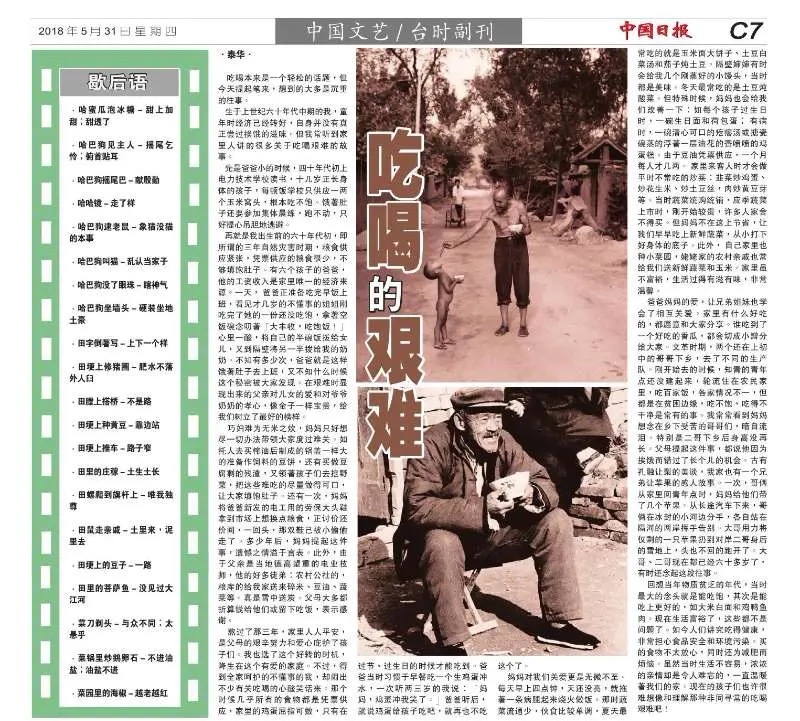
中文原文
那些吃不飽的歲月
文/泰華
2015年5月 寫於加拿大
第一章 父親的半碗飯
吃喝,本來是一個輕鬆的話題,但今天提起筆來,想到的大多是沉重的往事。
生於上世紀六十年代中期的我,童年時經濟已經轉好,自身並沒有真正嘗過挨餓的滋味。但我常聽家裡人講起許多關於吃喝艱難的故事。
先是爸爸小的時候。四十年代初,他在電力技術學校讀書。十幾歲正是長身體的年紀,每頓飯學校只供應一兩個玉米窩頭,根本吃不飽。餓著肚子還要參加集體晨練,跑不動,只好提心吊膽地躲著老師。
再就是我出生前的六十年代初,也就是所謂三年困難時期。糧食供應緊張,所有糧食都憑票供應,每人能分到的口糧十分有限。
家裡有六個孩子,爸爸的工資是全家唯一的經濟來源。
有一天,爸爸正準備吃完早飯去上班,看見才幾歲、不懂事的姐姐,吃完自己那一份後仍沒有吃飽,捧著空飯碗,一邊走一邊念叨:「大豐收,吃飽飯!」
爸爸聽了,心裡一酸,默默把自己碗裡的一半飯撥給了女兒,又把剩下的一半送到隔壁奶奶那裡。
不知道有多少次,爸爸就是這樣餓著肚子去上班;也不知道什麼時候,這個秘密才被家裡人知道。
在艱難歲月裡顯現出來的父愛,以及對父母的孝心,像金子一樣珍貴,也成了我們兄弟姐妹一生最好的榜樣。
第二章 母親的煙火
巧婦難為無米之炊。
媽媽只好想盡一切辦法,帶著一家人度過難關。
她托人去買榨油後準備做飼料的大豆餅,又買做豆腐剩下的豆渣,還領著孩子們去挖野菜,再想方設法把這些原本難以下嚥的食物做得可口一些,讓一家人能填飽肚子。
還有一次,媽媽把爸爸剛發下來的電工勞保大頭鞋拿到市場,想換一點糧食。正討價還價時,一回頭,那雙鞋已經被小偷偷走了。
很多年後,媽媽每次提起這件事,仍滿是遺憾。
此外,由於爸爸是當地德高望重的電業技師,不少徒弟分布在農村、公社、糧庫等單位。有時,他們會送來一些碎米、豆油、蔬菜等,真是雪中送炭。
父母總會盡量折算成錢還給他們,或留下他們一起吃頓飯,以表達感謝。
一家人就這樣熬過了最困難的三年。
回過頭來看,家裡人人平安,靠的是父母的辛勞,也靠的是他們彼此相愛、彼此承擔。
我也選了一個日子漸漸好轉的時候,降生在這個充滿愛的家庭。
第三章 家的味道
得到全家呵護、不懂事的我,也鬧出不少和吃有關的趣事。
那時候,雞蛋十分珍貴,只有過節或過生日時才能吃得到。
爸爸習慣早餐打一個生雞蛋沖水喝。
有一次,兩三歲的我望著碗裡的雞蛋,高興地說:
「媽媽,雞蛋沖我笑了。」
爸爸聽後,只笑著說:「雞蛋給孩子吃吧。」
從那以後,他再也沒有吃過這樣的早餐。
媽媽對我們的照顧,更是無微不至。
每天清晨四點,天還沒亮,她就拖著一條病腿起床燒火做飯。
那時蔬菜流通很少,夏天最常吃的是玉米麵大餅子、土豆白菜湯、茄子燉土豆;冬天最常吃的是酸菜燉土豆。
隔壁嬸嬸偶爾送來幾個剛出鍋的小饅頭,對我們來說,就是難得的美味。
每逢孩子生日,媽媽總會煮一碗生日麵,再打一個荷包蛋;誰生病了,就做一碗熱騰騰的疙瘩湯,或者蒸一碗浮著一層油花的雞蛋糕。
家裡來了客人,媽媽才會做平時捨不得做的炒菜:韭菜炒雞蛋、炒花生米、炒土豆絲、肉炒黃豆芽……
那時候,蔬菜統購統銷,剛上市的新鮮蔬菜價格較高,很多人家都捨不得買。
媽媽卻總說,孩子正在長身體。
她寧願在別處節省,也要讓我們早些吃上新鮮蔬菜。
家裡還種著小菜園,姥姥家的親戚也常送來新鮮蔬菜和玉米。
雖然日子並不富裕,卻過得有滋有味,滿屋都是家的溫暖。
第四章 飛過冰河的蘋果
爸爸媽媽的愛,也讓兄弟姐妹從小學會彼此分享。
家裡若有什麼好吃的,總願意分給大家。
一個香瓜,也要切成一小瓣、一小瓣,人人都有一份。
文革期間,兩位哥哥下鄉,去了不同的生產隊。
剛開始知青點還沒有建好,只能輪流住在農民家裡,吃百家飯。各家生活都很困難,吃不飽、吃得不好,是常有的事。
媽媽常常想念兩位哥哥,暗自落淚。
尤其是二哥,下鄉後身高便再也沒有長高。
父母一直覺得,那是因為在最需要營養的年紀,挨了太多餓。
古有孔融讓梨,我家也有一個兄弟讓蘋果的故事。
有一次,兄弟倆從家裡返回青年點,媽媽給他們帶了幾個蘋果。
下了長途汽車後,哥倆在一條冰封的小河邊分手,各自站在河的兩岸揮手告別。
就在轉身的一瞬間,大哥忽然用力,把僅剩的一個蘋果拋向對岸。
蘋果落在二哥身後的雪地上。
大哥沒有回頭,快步跑遠了。
如今,大哥、二哥都已六十多歲。
直到今天,他們偶爾還會談起那個冬天,談起那個飛過冰河的蘋果。
第五章 一碗飯裡的溫暖
回想那個物質匱乏的年代,人最大的願望,就是能夠吃飽。
再好一點,就是能吃上白米白麵,雞鴨魚肉。
如今,生活富裕了。
人們開始關心食品安全、營養均衡、環境污染,也開始為控制體重、保持健康而煩惱。
時代變了,飯桌變了,人們的煩惱也變了。
然而,那些吃不飽的歲月,卻始終留在記憶深處。
真正難忘的,不只是那些粗茶淡飯,也不只是那段艱苦的日子。
最令人難忘的,是父母在困難中仍然把最好的一口留給家人;是兄弟姐妹彼此分享、彼此扶持;是在缺乏之中,依然沒有減少的那份親情。
今天,每當端起一碗熱飯,我總會想起那些把自己的一口飯、一個雞蛋、一個蘋果,默默留給家人的人。
那些吃不飽的歲月早已遠去。
但那份在艱難中孕育出的愛,卻一直溫暖著我們,直到今天。
English Version 英文版(ChatGPT)
The Years When We Never Quite Had Enough to Eat
By Taihua
Written in Canada
May, 2015
Chapter One
My Father’s Half Bowl of Rice
Food is usually an easy topic to talk about. Yet whenever I think about it today, my mind returns not to flavors, but to memories filled with hardship.
Born in the mid-1960s, I grew up after the worst years had already passed. I never truly experienced hunger myself. But throughout my childhood, I listened to countless stories from my family about what it meant to struggle simply to find enough to eat.
My father’s memories reached back to the early 1940s, when he attended a technical school to study electrical engineering. As a teenage boy still growing, each meal consisted of little more than one or two corn buns. They were never enough.
After eating, the students were expected to join morning exercises. Hungry and weak, he often could not keep up, living in constant fear of being caught trying to avoid the drills.
Years later came the difficult period of the early 1960s.
Food was rationed. Every grain required coupons, and every family learned to count each meal carefully.
My parents were raising six children, and my father’s salary was the family’s only income.
One morning, just before leaving for work, he watched my little sister finish her breakfast. Holding her empty bowl, she innocently repeated the slogan she had heard everywhere:
“A great harvest! We’ll all have enough to eat!”
She was only a child. She had no idea why she was still hungry.
My father quietly divided his own breakfast in half, giving one portion to his daughter. Then he carried the remaining half to my grandmother next door.
No one knows how many mornings he went to work hungry.
Nor do we know when the rest of the family finally discovered what he had been doing.
Looking back, I realize that during those hardest years, my father’s love for his children and his devotion to his own parents became the greatest inheritance he ever gave us.
Chapter Two
My Mother’s Kitchen
As the old saying goes, even the cleverest cook cannot prepare a meal without rice.
My mother did everything she could to keep our family going.
She found soybean cakes left after oil extraction—normally used as animal feed. She collected leftover soybean pulp from tofu makers. She took us into the fields to gather wild vegetables, then somehow transformed those humble ingredients into meals that kept us alive.
One day she even carried my father’s brand-new work boots to the market, hoping to exchange them for grain.
While she was bargaining, someone stole them.
Decades later, she still spoke of that day with quiet regret.
Fortunately, my father was a respected electrical technician, and many of his former apprentices worked in farming communes, grain depots, and local cooperatives.
From time to time they quietly brought us broken rice, cooking oil, vegetables, or other necessities.
Their kindness came exactly when we needed it most.
My parents always insisted on paying what they could or inviting them to stay for a meal as a way of saying thank you.
Together, through hard work, kindness, and God’s grace, our family survived those difficult years.
I happened to be born just as life was beginning to improve.
Chapter Three
The Taste of Home
As the youngest child, surrounded by everyone’s love, I created a few memorable stories of my own.
Eggs were precious.
For most families, they appeared only on birthdays or special holidays.
My father used to drink a raw egg mixed with hot water every morning.
One day, when I was only two or three years old, I looked into the bowl and happily said,
“Mom, the egg is smiling at me.”
My father laughed.
“Then let the child have the egg,” he said.
From that day on, he never made that breakfast for himself again.
My mother’s love revealed itself in quieter ways.
Every morning, long before sunrise, she rose at four o’clock despite the pain in one of her legs, lighting the stove and preparing breakfast for the whole family.
Meals were simple.
In summer we often ate cornmeal flatbread, potato and cabbage soup, or stewed eggplant with potatoes.
In winter it was usually potatoes and sauerkraut.
Sometimes our neighbor would bring over a few freshly steamed buns.
To us, they tasted like a feast.
Birthdays meant a bowl of longevity noodles with a poached egg.
When one of us became sick, Mother would make a comforting bowl of dumpling soup or steam a bowl of silky egg custard, its surface shimmering with a few precious drops of cooking oil.
Guests were rare occasions for celebration.
Only then would she prepare dishes like scrambled eggs with Chinese chives, fried peanuts, shredded potatoes, or bean sprouts with pork.
Fresh vegetables were expensive when they first appeared each season, and many families waited until prices fell.
My mother never did.
“Children need fresh vegetables while they’re growing,” she would say.
She preferred to save money elsewhere rather than on our health.
We also grew vegetables in a small garden, and relatives from the countryside often brought us fresh corn and produce.
Life was never wealthy.
But our home was always rich in warmth.
Chapter Four
An Apple Across the Frozen River
The love our parents showed us naturally became the love we shared with one another.
Whenever someone found something delicious, it was divided equally among everyone.
Even a single melon became many small slices.
During the Cultural Revolution, my two older brothers were sent to different rural production teams.
In those early days, before the educated youth dormitories were built, they stayed with farming families.
Most households were struggling themselves.
Enough food was never guaranteed.
My mother often worried about them and quietly wept.
My second brother never grew any taller after leaving home.
My parents always believed hunger during those important growing years had stolen part of his childhood.
One story has remained with our family ever since.
Before my brothers returned to the countryside after visiting home, Mother packed a few apples for them.
After getting off the long-distance bus, they reached a frozen river where they had to part ways.
Standing on opposite banks, they waved goodbye.
Then, just before turning away, my older brother suddenly threw the very last apple across the frozen river.
It landed in the snow behind my younger brother.
Without looking back, he simply walked away.
Today both of them are in their sixties.
Yet every now and then, they still remember that winter…
and that single apple flying across the frozen river.
Chapter Five
A Bowl of Rice
Looking back, the greatest wish of those years was simply to have enough to eat.
If life became a little better, perhaps there would be white rice, wheat flour, meat, fish, or eggs.
Today, those dreams have long become ordinary life.
Instead, people worry about food safety, nutrition, pollution, and even losing weight.
Times have changed.
Our tables have changed.
Even our worries have changed.
Yet the memories of those hungry years remain.
What I remember most is not the hunger itself.
Nor is it the simple food.
It is the love that quietly placed the best portion into someone else’s bowl.
A father giving away half of his breakfast.
A mother rising before dawn every single day.
Brothers sharing their last apple.
Those years of not having enough to eat have long passed.
But the love they nurtured continues to nourish our family to this day.
Terms of Use
You are welcome to share and repost this work, provided that appropriate credit is given to the original creator. Prior written consent from the creator is required for any commercial application.
© 2026 Taihua. All rights reserved. (版权所有,翻版必究)
Instructions on Webpage Language Settings
It is recommended to set your browser’s default webpage language to English. This way, when you visit a Chinese webpage, the page will typically display both the original Chinese text and an English translation derived from the Chinese.
If you need to translate the content further into another language (or convert it into different Chinese characters/fonts), direct translation from Chinese is often inaccurate. In such cases, it is recommended that you refer directly to the English section on the page. Because translation tools generally handle “English-to-other-languages” translation with much higher accuracy, this approach will help ensure better reading comprehension and translation quality.
Choosing this approach to webpage language presentation is a way for our website to go global and provide diverse support. It enables human thought and memory to transcend the barriers of language, space, and time, which is the very purpose of this website.
關於網頁語言設定的說明
建議將瀏覽器的預設網頁語言設定為英文。這樣一來,當您訪問中文網頁時,頁面通常會同時呈現中文原文(簡體/繁體)以及由中文翻譯成的英文版本。
當您需要將網頁內容進一步翻譯成其他語言(或轉換為其他中文簡繁字體)時,由於直接從中文轉譯往往不夠準確,建議您直接參考頁面中的英文部分。因為絕大多數翻譯工具對「英文轉其他語言」的支持更加成熟和準確,這樣能夠有效提升最終的閱讀和理解質量。
選擇這種網頁語言呈現方式,是本網站走向國際、提供多元支持的重要方式。它讓人類的思想與記憶跨越語言、空間乃至時間的障礙,這正是本網站設立的宗旨。
Leave a Reply