
家裡有了蹦蹦(中文)
文/泰華
以前,我並不真正懂得養寵物的人。
看見有人推著嬰兒車一樣的小車,裡面坐的卻是一隻貓或一條狗,我偶爾也會覺得有些好笑。人與動物,真的需要親近到這個程度嗎?
直到蹦蹦來到我們家。
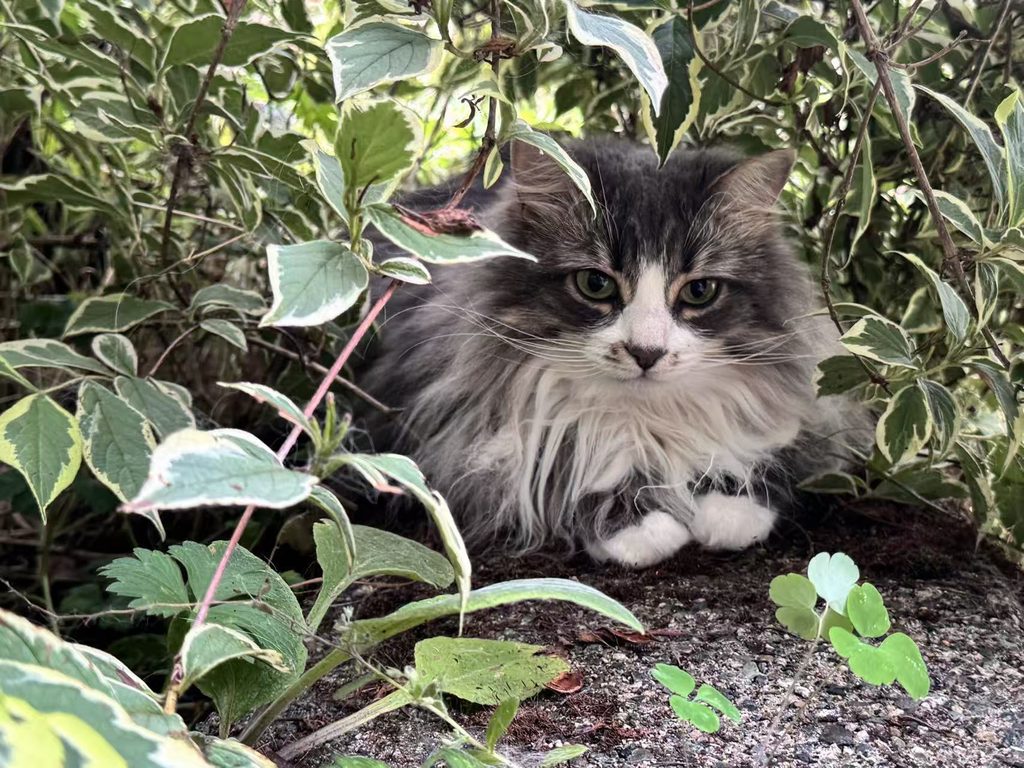
她來的時候還很小,瘦瘦的,最惹眼的是四隻小白爪,像穿著四隻小白襪。走起路來尤其有趣,不大肯老老實實地走,總愛一蹦一跳。我們看著好玩,索性給她起名叫“蹦蹦”。
她的好奇心大得很,哪裡都想去,什麼都想看。看到高處就往上爬,有時沒站穩,撲通一下摔下來;跑得太急,偶爾還會磕一下腦袋。摔了,爬起來,又去探索別的地方。
那時候,我們總要看著她,怕她跑出去,怕她摔著,怕她吃錯東西。
後來,我們從渥太華搬到溫哥華。四千多公里的飛行,她一路安安靜靜。我們住進十八樓的公寓,夏天需要開窗,可家裡多了一隻貓,窗戶便不能想開就開。
我陸續做了五扇紗窗。以前從沒想過,有一天我會為一隻貓量窗戶、買材料、做紗窗。可紗窗裝好,海風可以放心地吹進來,蹦蹦趴在窗邊看外面的天空,我的心也安穩了。
養一隻寵物,大概就是從這些小事開始改變一個人的。
每天要記得貓糧、水和貓砂。蹦蹦的腸胃比較敏感,食物不能隨便換。日子久了,這些事情也都成了生活的一部分。
可是慢慢地,我發現,我們給她的並不只是食物,她給我們的也不只是“可愛”。
她有自己的語言。
我有時五點多起夜,一開門,便看見她已經在外面等著。她看見了我,就不再抓門催促。我重新回到床上,她也安靜下來,有時一等就是幾個小時。
她似乎已經熟悉了我的生活規律,知道我還會起來,也不會忘記她。
等我真正起床,她便走在前面,帶我去廁所。她早已熟悉了這個習慣,知道我起床以後先要去那裡。
我如廁時,她就在腳前轉來轉去,蹭蹭牆角,也讓我摸摸她。過一會兒,她便往廚房走。
走幾步,又回來看看我。
我還沒動,她就再走一次。到了吃飯的地方,又折回來。
如此兩三次。
她並不急,也不大聲叫,只是一遍遍把這條路線“演示”給我看。
我漸漸讀懂了:
好了,該去吃飯了。
貓條是我們給蹦蹦的特殊獎勵,通常梳完毛、剪完指甲才給。有一次外出住在朋友家,帶去的貓糧有些不夠,我便把貓條擠進碗里,想臨時給她補一點。
誰知她聞了聞,竟然不吃。
後來還是像平常一樣,拿在手裡一點點擠給她,她才吃起來。
原來一隻貓,也有自己認定的生活方式。
蹦蹦想親近人,也有自己的方式。
我伸出一隻穿著拖鞋的腳,她有時會走過來,先蹭這一邊,再繞過去蹭另一邊。蹭完走開幾步,我再叫她一聲,把另一隻腳伸出去,她猶豫一下,居然又回來,認認真真地再蹭一遍。
不熱烈,也不糾纏。
想親近了,就靠近你;蹭一蹭,又回到自己的地方。
大約一歲多的時候,她還有一種特別的打招呼方式。
那時我們住的房子有樓上、樓下和地下室。樓梯旁有一段欄桿,她很喜歡蹲在那裡,像守著一座小小的瞭望台。
有時我們從下面走過,肩膀忽然被輕輕拍一下。
回頭一看——
蹦蹦蹲在欄桿旁,伸著一隻小白爪。
那個高度,剛剛好。
家裡偶爾有護工來,其中一位特別怕貓,也被她這樣拍過,嚇了一跳。從那以後,有護工來,我們便先把蹦蹦留在房間里。
同樣一隻小白爪,給我們的是驚喜,給怕貓的人卻可能是驚嚇。養她也讓我明白:喜歡自己的寵物,也要尊重別人和它保持距離的權利。
如今,蹦蹦已經三歲多了。
小時候那個瘦瘦的、毛毛躁躁的小傢伙,漸漸多了一份從容。她還是好奇,卻不像幾個月大時那樣什麼都急著衝過去。
有時她端端正正坐著,兩只小白腳並在一起,偶爾還把其中一隻輕輕收起來,竟有幾分優雅。
我們也開始給她多一點自由。
天氣好的時候,我常讓她到門外活動。她喜歡草地,也喜歡鑽進不遠處的樹叢。開始的時候,只要看不見她,我就趕緊出去找。
後來發現,她通常並沒有走遠。有時就在樹叢下面。我叫她,她耳朵動一動,身子卻依舊背對著我。等自己想回來了,才轉過身看看我。
有一次我們一時找不到她,我正準備往遠處去找,忽然看見一個小小的身影從人行道那邊一路跑回來,直奔家門。
其實一年多以前,我們到溫哥華島在朋友家住了一個星期,她就曾意外跑出去。那個地方完全陌生,我們正著急,她卻自己回來了。
那時我只覺得幸運。
現在回頭看,也許她很早就開始辨認:我們在哪裡,哪裡就是那一刻的家。
當然,我從不敢因此完全放心。
她會回家,不等於每一次都不會有意外。她在外面待一段時間,我還是會出去看看。全家準備出門以前,更有一件事情不能省——找到蹦蹦。
有時她藏在屋裡,叫也不回答,我就一個地方一個地方找。屋裡沒有,就到外面把她找回來。親眼看見她安全地待在屋裡,我們才鎖門離開。
我漸漸懂得,信任不是放任。
後來,我自己也給蹦蹦買了一輛寵物推車,偶爾推著她到海邊步道走走。她站在網狀的車廂里,看飛鳥,看行人,眼睛不停地轉。
有人看見車里坐的是一隻貓,會笑著走過來。
這時候,我也會想起從前那個看到別人推寵物車、覺得有些好笑的自己。
沒想到,有一天,我也成了其中的一個。
前些天的一個下午,蹦蹦出去玩了一會兒,又回到門前朝屋裡望瞭望。
我覺得,她好像是在找我。
於是我走出去,在門外的椅子上坐下。
她看見我,便在附近安靜地待著。一會兒趴著,一會兒打個滾,偶爾走到我的腳邊,輕輕蹭蹭拖鞋,然後又走開。
我沒有逗她,她也沒有一直黏著我。
她待在那裡。
我也坐在那裡。
風吹過來,樹葉輕輕動著。
那一刻,我突然覺得,我以前對“養寵物”這件事情的理解,也許一直少了一點什麼。
我們常說,是人在養一隻貓。
我們買食物,清貓砂,替她做紗窗,擔心她跑出去。可是相處久了,我越來越不覺得這只是一種單向的照顧。
早晨,有一個小生命在門外等著我;我伸出一隻腳,她會過來蹭一蹭;我坐到門外,她就在不遠處安靜地待著。
我與兒子之間,也常常因為她多了一個共同的話題。她不懂我們說的那些事情,卻在不知不覺間,成了兩代人之間一座小小的橋。
也許,這就是寵物帶給人的東西。
它們不能替我們解決人生的問題,也不會說什麼安慰人的話。它們只是進入我們每天的生活,需要我們,也陪伴我們。
而我們在照顧它們的年月里,也一點點學會耐心,學會責任,學會尊重另一個生命自己的性情。
蹦蹦就在我的椅子旁邊。
她玩她的。
我坐我的。
偶爾,她抬頭看我一眼。
我也看看她。
誰都沒有說話。
可是我知道——
她陪著我。
我也陪著她。
Life with Bengbeng(English Version Interpreted by ChatGPT)
By Taihua
I never really understood people who were devoted to their pets.
Whenever I saw someone pushing what looked like a baby stroller, only to discover a cat or dog sitting inside, I sometimes found it a little amusing. Did people and animals really need to become that close?
Then Bengbeng came into our home.
She was tiny and skinny, with four little white paws that looked as though she were wearing white socks. The way she walked was especially funny. Instead of simply walking from place to place, she loved to bounce and hop along. We found it so endearing that we named her Bengbeng, a name that suggests bouncing in Chinese.
Her curiosity was boundless. She wanted to go everywhere and investigate everything. Whenever she saw something high, she tried to climb it. Sometimes she lost her footing and tumbled down. Sometimes, rushing around too eagerly, she bumped her head. She would pick herself up and immediately set off to explore somewhere else.
Back then, we were always keeping an eye on her.
We worried that she might run outside, fall from somewhere, or eat something she shouldn’t.
Later, we moved from Ottawa to Vancouver. It was a journey of more than four thousand kilometres, and through the long flight she remained remarkably quiet.
In Vancouver, we lived on the eighteenth floor of an apartment building. Summers called for open windows, but with a cat in the house, we could no longer open them without thinking.
So I began making window screens. First two or three, then a few more, until eventually I had made five.
I had never imagined that one day I would be measuring windows, buying materials, and building screens for a cat.
But once they were in place, the sea breeze could come safely through the windows while Bengbeng sat there watching the sky. I felt more at ease too.
Perhaps this is how living with a pet begins to change a person—through small things.
There is cat food to remember, fresh water to provide, and litter to clean. Bengbeng has a sensitive stomach, so we have to be careful about changing her food. After a while, all these little responsibilities simply became part of everyday life.
Gradually, however, I began to realize that what we gave her was more than food, and what she gave us was more than cuteness.
She had a language of her own.
Sometimes I get up around five in the morning to use the bathroom. When I open the bedroom door, Bengbeng is already outside waiting.
Once she sees me, she stops scratching at the door. I go back to bed, and she settles down again. Sometimes she will wait quietly for several more hours.
She seems to know my routine by now. She knows I will get up eventually, and she knows I won’t forget her.
When I finally do get up, she walks ahead of me toward the bathroom. She already knows that this is where I go first.
While I am there, she circles around my feet, rubs against the corner of the wall, and lets me stroke her. After a while, she heads toward the kitchen.
A few steps later, she comes back to check on me.
I haven’t moved.
So off she goes again.
She reaches the place where she eats, then turns around and comes back.
She may repeat this two or three times.
She doesn’t make a fuss or meow impatiently. She simply demonstrates the route over and over.
Eventually, I learned to understand:
All right. It’s time for breakfast.
Bengbang has her own habits when it comes to treats as well.
We usually give her a cat treat after grooming or trimming her claws, as a special reward for cooperating. We hold the tube in our hands and squeeze out a little at a time while she licks it.
Once, while we were staying with friends, we found ourselves running a little short of the cat food we had brought. Since Bengbang’s stomach is sensitive, we didn’t want to give her unfamiliar food. I remembered that we still had a few tubes of treats, so I squeezed one into a bowl, thinking it could tide her over.
She came over, sniffed it—and wouldn’t touch it.
Eventually, I picked up another tube and fed her the usual way, squeezing out a little at a time.
Then she ate.
Apparently, even a cat has her own ideas about how things should be done.
Bengbeng also has her own way of showing affection.
Sometimes I hold out one slippered foot. She walks over slowly, rubs against one side, circles around, and rubs the other.
Then she walks away.
I call her again and hold out my other foot.
She pauses, thinks about it, and comes back to give that one the same careful treatment.
Her affection is never overwhelming.
She comes close when she wants to, rubs against you for a moment, then returns to her own space.
When she was a little over a year old, she had another unusual way of saying hello.
The house where we lived then had an upper floor, a main floor, and a basement. Beside the staircase was a railing where Bengbeng loved to perch. It was her little observation post, a place from which she could watch everyone going up and down.
Sometimes, as we walked up the stairs, we would suddenly feel a light tap on the shoulder.
We would turn around—
and there was Bengbeng beside the railing, one little white paw stretched out toward us.
The height was just right.
Someone in our family needed care at the time, so caregivers occasionally came to the house. One of them was particularly afraid of cats. Bengbeng once gave him the same unexpected tap on the shoulder and startled him badly.
After that, whenever a caregiver came, we kept Bengbeng in another room.
The same little white paw that delighted us could frighten someone else.
Living with her taught me something else: loving your own pet also means respecting another person’s wish to keep some distance.
Bengbeng is now more than three years old.
The skinny, impulsive kitten has gradually become more composed. She is still curious, but she no longer rushes headlong into everything as she did when she was only a few months old.
Sometimes she sits perfectly upright, her two white front paws neatly together, occasionally tucking one beneath her. There is almost an air of elegance about her now.
We have also begun giving her a little more freedom.
When the weather is pleasant, I sometimes let her spend time outside near the house. She likes the grass and especially enjoys disappearing beneath the nearby bushes.
At first, whenever I couldn’t see her, I hurried outside to look.
Eventually, I realized that she usually hadn’t gone far.
Sometimes she was simply sitting beneath the bushes. I would call her. An ear might twitch, but she would keep her back turned to me.
She wasn’t ready to come home.
When she was, she would turn around and look at me.
Once, when we couldn’t find her, I was about to search farther away when suddenly a small figure came running along the path.
Straight home.
More than a year earlier, we had already seen a glimpse of this ability. We were staying for a week at a friend’s home on Vancouver Island, a completely unfamiliar place for Bengbeng. One day she slipped outside without us noticing.
When we realized she was missing, we began to worry.
Then, after a while, she came back on her own.
At the time, I thought we had simply been lucky.
Looking back, perhaps she had already begun to understand something important: wherever we were, that was where home was for the moment.
Still, I never take her return for granted.
Knowing how to come home doesn’t mean nothing can go wrong. If she has been outside for a while, I still go and check on her. And whenever everyone in the house is about to leave, there is one thing we never skip:
Find Bengbeng.
Sometimes she is hiding somewhere indoors and doesn’t respond when we call. So I search from place to place. If she isn’t inside, I go outdoors and bring her back.
Only when I have actually seen her safely inside can we lock the door and leave.
I have come to understand that trust is not the same as letting go of responsibility.
Some time ago, I even bought Bengbeng a pet stroller.
Now and then I take her along the seaside path. She stands inside the mesh enclosure, watching birds fly overhead and people pass by, her eyes constantly moving from one thing to another.
Sometimes people notice that the passenger in the stroller is a cat and come over smiling.
At moments like that, I remember the person I used to be—the one who found it amusing to see someone pushing a pet in a stroller.
I never imagined I would become one of them.
One afternoon recently, Bengbeng had been outside for a while when she came back to the door and peered inside.
It seemed to me that she was looking for me.
So I went outside and sat down in a chair near the door.
When she saw me, she settled nearby.
Sometimes she lay down. Sometimes she rolled over. Now and then she wandered over and rubbed gently against my slippers before moving away again.
I wasn’t entertaining her.
She wasn’t clinging to me.
She was simply there.
And so was I.
A breeze moved through the leaves.
In that quiet moment, I suddenly realized that something had always been missing from my old understanding of what it meant to have a pet.
We often say that we take care of a cat.
We buy her food, clean her litter, make window screens for her, and worry when she goes outside.
But after living together for long enough, I no longer think of it as care flowing in only one direction.
In the morning, a small living creature waits outside my door.
When I hold out a foot, she comes over to rub against it.
When I sit outside, she stays quietly somewhere nearby.
She has even become a small bridge between my son and me, giving us something we naturally return to in conversation.
Perhaps this is what pets bring into our lives.
They cannot solve our problems, nor can they offer words of comfort.
They simply enter the ordinary rhythm of our days.
They need us.
And they keep us company.
In caring for them over the years, we also learn something ourselves: patience, responsibility, and respect for the nature of another living being.
Bengbeng is beside my chair.
She does her thing.
I do mine.
Every now and then, she looks up at me.
I look back at her.
Neither of us says a word.
But I know—
she is keeping me company.
And I am keeping her company.
Terms of Use
You are welcome to share and repost this work, provided that appropriate credit is given to the original creator. Prior written consent from the creator is required for any commercial application.
© 2026 Taihua. All rights reserved. (版权所有,翻版必究)
Instructions on Webpage Language Settings
It is recommended to set your browser’s default webpage language to English. This way, when you visit a Chinese webpage, the page will typically display both the original Chinese text and an English translation derived from the Chinese.
If you need to translate the content further into another language (or convert it into different Chinese characters/fonts), direct translation from Chinese is often inaccurate. In such cases, it is recommended that you refer directly to the English section on the page. Because translation tools generally handle “English-to-other-languages” translation with much higher accuracy, this approach will help ensure better reading comprehension and translation quality.
Choosing this approach to webpage language presentation is a way for our website to go global and provide diverse support. It enables human thought and memory to transcend the barriers of language, space, and time, which is the very purpose of this website.
關於網頁語言設定的說明
建議將瀏覽器的預設網頁語言設定為英文。這樣一來,當您訪問中文網頁時,頁面通常會同時呈現中文原文(簡體/繁體)以及由中文翻譯成的英文版本。
當您需要將網頁內容進一步翻譯成其他語言(或轉換為其他中文簡繁字體)時,由於直接從中文轉譯往往不夠準確,建議您直接參考頁面中的英文部分。因為絕大多數翻譯工具對「英文轉其他語言」的支持更加成熟和準確,這樣能夠有效提升最終的閱讀和理解質量。
選擇這種網頁語言呈現方式,是本網站走向國際、提供多元支持的重要方式。它讓人類的思想與記憶跨越語言、空間乃至時間的障礙,這正是本網站設立的宗旨。