
山海之間之一:山海迴響(中文)
文/泰華
2026年夏,寫於加拿大西海岸
第一部分 與海相識
我已記不得這是第幾次,把那艘小艇推進海裡。
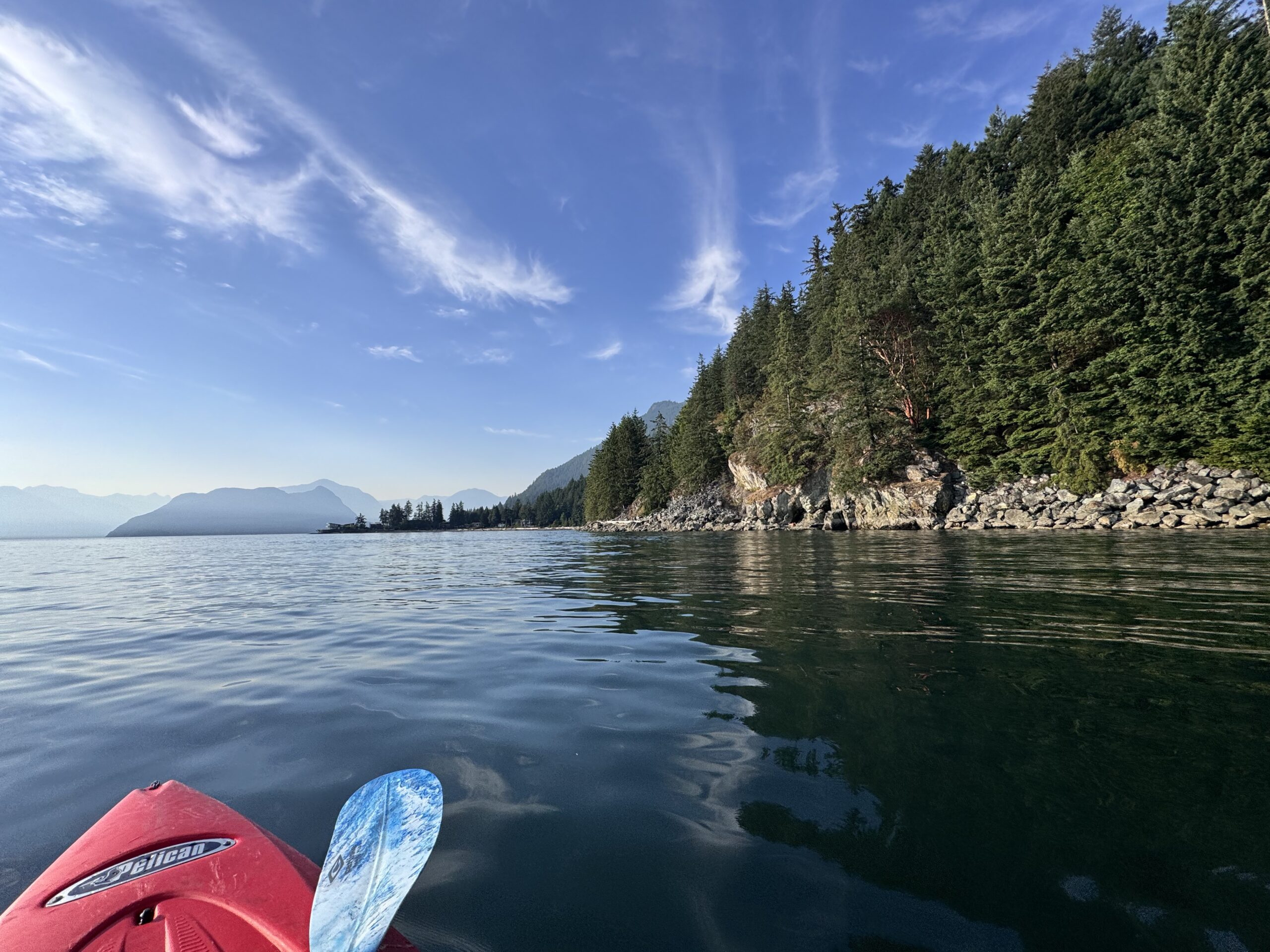
船離開岸邊,水面恢復平靜,彷彿什麼也沒有發生。只有船頭劃開一道細細的波紋,向遠方舒展。海風吹來,夾著淡淡的鹹意。我迎著海風,向海灣深處划去。
一年四季,我都從這裡出發。春天的新綠、夏天的暖陽、秋天的微涼、冬天的雪山;晴天、細雨,潮起、潮落,都成了這段航程的一部分。新鮮與好奇,也在一次次出航中,化作熟悉與親近。
群山映入眼前,島嶼散落海面。大海並非一望無際,而是在群山與島嶼間舒展。雨水滋養著岸邊的森林,層層綠意一路延伸到海邊。小艇穿行其間,四周只剩槳聲。
沿岸分布著一棟棟臨海而建的房屋,有的現代簡潔,有的保留著西海岸木屋的風格。許多房屋前都有伸向海面的私人碼頭,露臺上擺著幾張休閒椅。有人端著咖啡,有人捧著書,也有人望著海,坐了很久。
船從岸邊划過,偶爾有人朝我揮手,我也笑著回應。我們彼此素不相識,也從未說過一句話,卻一點也不覺得陌生。
他們世代依海而居,熟悉海風,也熟悉潮汐,是這片海的兒女。而划著小艇的我,不知不覺也成了他們眼中海的一部分。海沒有介紹我們,卻讓我們彼此認出了對方。
晴朗的日子,海面平靜如鏡。群山、森林、藍天白雲,都映在水裡。小艇行於海上,也行於天空。微風吹過,海面泛起波紋,山、水與天空的倒影隨之蕩漾。
陽光灑落,是一天中最動人的時刻。每划下一槳,都像從海裡舀起一勺陽光。槳葉帶起晶瑩的水珠,在陽光下閃耀,又落回海裡。我一時竟分不清,飛濺的是海水,還是陽光。遠處的波光碎成無數跳動的光點,在海面不停閃爍。
有時,我會停下船槳,任小艇隨波漂流,把手放進海水裡。
冬天,海水冰涼刺骨,寒意順著指尖漫上手臂;夏天,它依然清涼,帶著大海特有的清冽。起初,我總會很快把手縮回來;後來,我試著多停留一會兒。海水漫過手掌,從指縫間流過。冰冷漸漸退去,只剩細膩柔滑的觸感。水流滑過掌心,沒有聲音,只讓人捨不得把手收回來。
直到那時,我才真正認識這片海。
它有遼闊,也有溫柔。
它托著小艇,也托住了我的掌心。
船繼續向前,船槳起落,波紋向遠方散去。我常覺得,槳聲是我說的話;波紋,是大海寫下的回信。沒有一句語言,卻彼此明白。
從那以後,出海已不只是看風景。我學著傾聽海風、潮汐、船槳劃開海面的聲音,也傾聽自己的心。
原來,真正安靜下來的,並不是大海。
而是自己的心。
第二部分 生命的風景
這裡,是加拿大西海岸一處寧靜的海灣。
真正吸引我的,不只是山海,還有生活在這片海上的生命。每次出海,都會遇見不同的牠們。
冬天,是海豹最常出現的季節。海灣裡有兩處海豹聚集的地方。遠遠望去,只像幾塊黑色的礁石。等小艇慢慢靠近,才發現那些黑影,原來是一隻隻海豹。
有一次,我看見六隻海豹躺在岩石上曬太陽。五隻睡得很沉,只有一隻始終抬著頭,不時望向四周,像一位放哨的衛兵。直到我的小艇划近,牠最先發現了我,其他海豹也陸續醒來,一隻接著一隻滑入海中,只留下幾圈漣漪,在墨綠色的海面散開。
整個冬天,在那兩處岩石附近,我大約見過二十多隻海豹。牠們有的全身烏黑,有的灰白相間,各有神情,也各有警覺。
另一群令我難忘的,是海獅。
有一次,我遇見七隻海獅。牠們時而浮出水面,時而潛入水中,在海裡快速穿梭,彼此追逐。我沒有刻意靠近,只順著自己的航向划行;不知不覺,小艇與牠們已近在咫尺。
我清楚聽見牠們浮出水面換氣時粗重的喘息,也聽見鼻孔噴氣的聲音,像一聲聲急促的噴嚏,在寧靜的海面格外清晰。當牠們猛然發現我的小艇時,幾乎同時發出響亮的叫聲,隨即四散游開。那叫聲掠過海面,在群山間久久迴響。
海裡的小魚,也常帶來驚喜。有一次,一條銀白色的小魚忽然躍出水面,又連續躍起兩次,在陽光下畫出三道晶亮的弧線,轉眼便消失在海裡。短短幾秒,卻讓人久久難忘。
岸邊常有巨大的漂木。有的還連著盤根錯節的樹根,有的只剩光滑的樹幹,也有些仍帶著翠綠的枝葉,彷彿剛離開森林,又開始另一段旅程。
漂木上常停著海鷗,有時一隻,有時數隻,高低錯落地站著。遠遠望去,竟讓我想起中國古代宮殿屋脊上的脊獸,靜靜守望著山海,也守望著歲月。
山坡上,偶爾還能看見被山火燒焦的大樹。漆黑的樹幹依然挺立;有些樹木早已失去樹皮,只剩灰白的樹身,默默站在風雨之中。
它們雖然失去了生命,卻依然挺立。
海豹、海獅、海鳥、小魚、漂木、枯樹……都以自己的方式,留在這片山海。
後來我才明白,生命並不只有一種模樣。
第三部分 山海晚霞裡歸航
一年又一年,這片山海總以不同的模樣迎接我。
夏天的清晨,海面常被濃霧籠罩。遠處的群山若隱若現,彷彿一幅尚未完成的水墨畫。小艇穿行其中,世界變得格外安靜,耳邊只剩槳葉劃開水面的聲音。眼前的一切忽遠忽近,讓人分不清,自己究竟是在海上,還是在畫裡。
冬天,遠方的群山披上白雪。
獅子峰雄踞天際,雙姐妹峰靜靜相伴。陽光照在雪峰上,潔白而明亮;海面倒映著山影,天地上下,相互輝映。熟悉的山,因四季而變;熟悉的海,也因光影有了不同的神情。
我最喜歡的,是傍晚回航的時刻。
夕陽緩緩落向海平線,天上一道金光,水裡也一道金光。遠山、森林、小艇,都浸在溫暖的餘暉裡。船槳輕輕落下,又慢慢抬起,彷彿不願驚動這片寧靜。
那一刻,我常想起古人泛舟江上的情景。
千百年前,有人臨水而歌,有人把酒問月,有人寄情山水,也有人在江湖之間尋找人生的答案。古人早已遠去,山水依舊;而今天的我,也只是天地間一位平凡的過客,在同一片山海之間,靜靜划過。
返航時,岸邊愈來愈近。
我知道,旅程終將結束;可山還在,海還在,潮汐日復一日地來去。那些風景、生命、風聲與浪聲,早已留在心裡。
第四部分 山海迴響
我漸漸明白,山海給人的,不只是壯麗的景色。
它教人耐心,教人謙卑,也教人學會傾聽——傾聽風,傾聽浪,傾聽萬物,也傾聽自己的心。
船靠岸了。
我回頭望向那片熟悉的海。
它依然平靜,彷彿什麼都沒有發生。
而我知道,每一趟航程,都在心裡留下山海的迴響。
每一次回來的我,已然不同。
Between Mountain and Sea I: LineMountain Echoes(English by ChatGPT)
By Taihua
Written on the West Coast of Canada, Summer 2026
Part One: Coming to Know the Sea
I can no longer remember how many times I have pushed that little kayak into the sea.
As the boat leaves the shore, the water grows calm again, as though nothing has happened. Only a slender wake opens before the bow and stretches into the distance. The sea breeze carries a faint taste of salt as I paddle into it, heading deeper into the bay.
I set out from this same place in every season: amid the fresh green of spring, the warm sun of summer, the coolness of autumn, and the snow-covered mountains of winter. Clear skies and gentle rain, rising tides and falling tides—all have become part of these journeys. With every outing, novelty and curiosity have gradually given way to familiarity and affection.
Mountains rise before me, and islands lie scattered across the water. Here, the sea is not an endless expanse; it unfolds between mountains and islands. Rain nourishes the forests along the shore, and layer upon layer of green descends all the way to the water. As my kayak passes through them, nothing remains but the sound of my paddle.
Houses stand along the shoreline. Some are sleek and modern; others retain the timbered character of the West Coast. Many have private docks extending into the water, with lounge chairs arranged on their terraces. Some residents sit with coffee in hand, some are absorbed in books, and others simply gaze at the sea for a long time.
As I paddle past, someone will occasionally wave. I smile and wave back. We do not know one another and have never exchanged a word, yet somehow we do not feel like strangers.
They have lived beside the sea for generations. They know its winds and tides; they are its sons and daughters. And without realizing it, I, too, have become part of the seascape in their eyes—a solitary figure moving through the water in a small kayak. The sea never introduced us, yet it allowed us to recognize one another.
On clear days, the water lies still as a mirror. Mountains, forests, blue sky, and white clouds are all reflected upon its surface. The kayak travels across the sea and, at the same time, across the sky. When a breeze passes, ripples spread over the water, setting the reflections of mountain, sea, and sky gently swaying.
The most beautiful moment comes when sunlight spills across the bay. Each stroke of the paddle seems to scoop a ladleful of sunshine from the sea. Crystal droplets rise from the blade, glitter in the light, and fall back into the water. For a moment, I cannot tell whether it is seawater or sunlight that is flying through the air. In the distance, the shimmer breaks into countless dancing points of light.
Sometimes I stop paddling and let the kayak drift with the waves while I lower one hand into the sea.
In winter, the water is piercingly cold, and the chill travels from my fingertips up my arm. Even in summer, it remains cool and carries the sea’s distinctive clarity. At first, I would quickly pull my hand away. Later, I began leaving it there a little longer.
The water rises over my palm and flows between my fingers. Gradually, the shock of cold recedes, leaving only a smooth, silken touch. The current slips soundlessly across my skin until I no longer wish to withdraw my hand.
Only then did I truly come to know this sea.
It is vast, yet it is gentle.
It carries my kayak, and it cradles my palm.
The boat moves on. The paddle rises and falls, and ripples travel into the distance. I often feel that the sound of the paddle is my voice, while the spreading ripples are the sea’s written reply. Not a word is spoken, yet we understand each other.
From then on, going out on the water was no longer simply a way to admire the scenery. I began learning to listen—to the sea breeze, the tides, and the sound of the paddle parting the water. I also began listening to my own heart.
In the end, it was not the sea that had grown quiet.
It was my heart.
Part Two: The Many Forms of Life
This is a tranquil bay on Canada’s West Coast.
What draws me here is not only the meeting of mountain and sea, but also the lives that inhabit these waters. Every voyage brings a different encounter.
Winter is the season when seals appear most often. There are two places in the bay where they gather. From a distance, they look like a few dark rocks. Only as the kayak approaches slowly do those dark shapes reveal themselves as seals.
Once, I saw six seals basking on a rocky outcrop. Five were sound asleep, while one kept its head raised, glancing around from time to time like a sentry on watch. It was the first to notice me as my kayak drew near. The others gradually woke, then slipped one after another into the sea, leaving only a few rings of ripples spreading across the dark green water.
Over the course of that winter, I saw more than twenty seals around those two rocky outcrops. Some were entirely black; others were mottled grey and white. Each had its own expression and its own degree of caution.
Another unforgettable encounter was with a group of sea lions.
One day, I came upon seven of them. They surfaced and dived, darting through the water and chasing one another. I made no effort to approach them and simply continued along my course. Before I realized it, my kayak was almost among them.
I could clearly hear their heavy breathing as they surfaced for air, along with the explosive sounds from their nostrils—like a succession of hurried sneezes, startlingly clear across the quiet water. When they suddenly noticed my kayak, they all seemed to cry out at once before scattering in different directions. Their calls swept across the bay and echoed among the mountains long afterward.
Even the small fish bring moments of wonder. Once, a silver fish suddenly leapt from the water, then rose twice more, tracing three bright arcs in the sunlight before disappearing beneath the surface. The whole encounter lasted only a few seconds, yet it remained with me.
Great pieces of driftwood often lie along the shore. Some still carry tangled masses of roots; others have been worn down to smooth, bare trunks. A few even retain green branches, as though they have only just left the forest and begun another journey.
Gulls often perch on the driftwood—sometimes alone, sometimes in small groups, arranged at different heights. Seen from a distance, they remind me of the ornamental guardian beasts along the roof ridges of ancient Chinese palaces, silently watching over the mountains and sea, and over the passing years.
On the slopes, I sometimes see trees blackened by wildfire. Their charred trunks remain upright. Others have long since lost their bark, leaving only pale grey bodies standing silently through wind and rain.
Though life has left them, they remain standing.
Seals, sea lions, seabirds, fish, driftwood, and dead trees—all remain within these mountains and waters in their own way.
Only later did I understand that life does not have a single form.
Part Three: Returning Through the Evening Glow
Year after year, these mountains and waters greet me in a different guise.
On summer mornings, thick fog often covers the bay. Distant mountains appear and disappear like forms in an unfinished Chinese ink painting. As the kayak moves through the mist, the world becomes exceptionally quiet, and all I can hear is the paddle parting the water. Everything before me seems to drift nearer and farther away, until I can no longer tell whether I am travelling across the sea or through a painting.
In winter, the distant mountains are draped in snow.
Lion Peak commands the skyline, while the Twin Sisters stand quietly beside it. Sunlight falls upon the snowy summits, making them pure and brilliant. Their reflections descend into the sea, and heaven and earth answer one another above and below. The familiar mountains change with the seasons, and the familiar sea assumes a different expression with every shift of light.
My favourite time is the journey home at dusk.
The sun slowly descends toward the horizon. A path of gold stretches across the sky, and another lies upon the water. Mountains, forests, and kayak are immersed in the warmth of the afterglow. The paddle enters the water gently and rises again with equal care, as though unwilling to disturb the stillness.
At such moments, I often think of the ancient poets and wanderers who travelled by boat along China’s rivers.
Centuries ago, some sang beside the water; some raised their wine to question the moon. Some entrusted their feelings to mountains and rivers, while others searched for the meaning of life amid waterways and distant shores. They have long since departed, but the mountains and waters remain. And today, I, too, am only an ordinary traveller beneath heaven and earth, quietly passing between mountain and sea.
As I return, the shoreline draws steadily nearer.
I know that every journey must end. Yet the mountains remain, the sea remains, and the tides continue their daily rising and falling. The landscapes, the living creatures, the wind, and the sound of the waves have already found a place within me.
Part Four: Echoes of Mountain and Sea
Gradually, I have come to understand that mountains and sea offer us more than magnificent scenery.
They teach us patience. They teach us humility. And they teach us to listen—to the wind, to the waves, to all living things, and to our own hearts.
The kayak reaches the shore.
I turn and look back at the familiar sea.
It is calm again, as though nothing has happened.
Yet I know that every journey leaves an echo of mountain and sea within my heart.
Each time I return, I am no longer quite the same.
Terms of Use
You are welcome to share and repost this work, provided that appropriate credit is given to the original creator. Prior written consent from the creator is required for any commercial application.
© 2026 Taihua. All rights reserved. (版权所有,翻版必究)
Instructions on Webpage Language Settings
It is recommended to set your browser’s default webpage language to English. This way, when you visit a Chinese webpage, the page will typically display both the original Chinese text and an English translation derived from the Chinese.
If you need to translate the content further into another language (or convert it into different Chinese characters/fonts), direct translation from Chinese is often inaccurate. In such cases, it is recommended that you refer directly to the English section on the page. Because translation tools generally handle “English-to-other-languages” translation with much higher accuracy, this approach will help ensure better reading comprehension and translation quality.
Choosing this approach to webpage language presentation is a way for our website to go global and provide diverse support. It enables human thought and memory to transcend the barriers of language, space, and time, which is the very purpose of this website.
關於網頁語言設定的說明
建議將瀏覽器的預設網頁語言設定為英文。這樣一來,當您訪問中文網頁時,頁面通常會同時呈現中文原文(簡體/繁體)以及由中文翻譯成的英文版本。
當您需要將網頁內容進一步翻譯成其他語言(或轉換為其他中文簡繁字體)時,由於直接從中文轉譯往往不夠準確,建議您直接參考頁面中的英文部分。因為絕大多數翻譯工具對「英文轉其他語言」的支持更加成熟和準確,這樣能夠有效提升最終的閱讀和理解質量。
選擇這種網頁語言呈現方式,是本網站走向國際、提供多元支持的重要方式。它讓人類的思想與記憶跨越語言、空間乃至時間的障礙,這正是本網站設立的宗旨。