
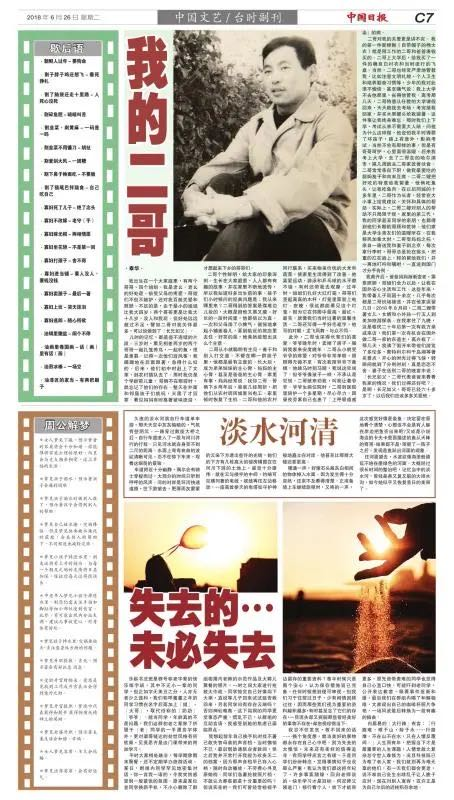
我的二哥(中文)
文/泰華
我出生在一個大家庭里,有兩個哥哥、四個姐姐。我是老幺。老幺的好處是,倍受父母的疼愛,哥姐們不但不嫉妒,還對我百般關愛和照顧。不足的是,由於最小的姐姐比我大四歲,兩個哥哥更是比我大十幾歲,沒人和我玩。但好處遠遠超過不足,譬如二哥對我關懷最多,可以說做到了“長兄如父”。
兒時的記憶,都是些不連續的片段。三歲時,看見相差兩歲的兩個哥哥一起扎籠養鳥,一起釣魚,很是羨慕。記得一次他們放風箏,我蹣跚地在後面跟著,急得什麼似的。後來,他們初中時趕上了文革,到農村插隊去了。那時我仍是個學齡前兒童,哥倆不在眼前時,就忘記了他們的存在。整天在外面和鄰居孩子們瘋玩,天黑了才回家。看見媽媽有時靠著被垛流淚,才想起來下鄉的哥哥們。
二哥個性鮮明,給大家的印象深刻。生長在大家庭里,人人都有有趣的故事,並在家裡不斷地流傳,所以我知道好多出生前的事。孩子們小時候問的經典問題是:我從哪裡來?二哥得到的答案是煤堆邊兒撿的,大概是因他又黑又瘦。好長的一段時間里,他都信以為真。一次和父母鬧了小脾氣,倔強地拿起小鋪蓋卷兒,要到臨近的旅店裡去住。好笑的是,他竟然能想出這麼個主意。
二哥從小就聰明有主見,善於和別人打交道。不管在哪一群孩子里,他都是最有主意的。長大後,成為弟弟妹妹的主心骨、媽媽的主心骨,甚至是爸爸的主心骨。家裡有事,媽媽經常說:找你二哥。哥倆下鄉兩年後,爸爸幾經周折,把他們從農村調回城裡當電工。家裡頓時恢復了生機。二哥和他的農村同行聯繫,買來物美價優的大米和蔬菜,使家裡生活得到了改善。他喜愛運動,游泳和乒乓球的水平都不錯,有時還帶我去觀摩。過年時,姐姐們扎好大紅燈籠,哥哥們竪起高高的木桿,燈籠裡面裝上電燈。夜晚,很遠都能看見這個燈籠,因為它在鄰居中最高、最紅、最亮,就像我們當時過著的溫馨生活。二哥還寫得一手好毛筆字,他寫的對聯,龍飛鳳舞,與眾不同。
此外,二哥也深得長輩們的喜愛。爺爺晚年時,賣掉了房子,搬到我家來安度晚年。二哥從小就受爺爺的疼愛,對爺爺非常孝順,照顧得無微不至。有次我陪爺爺下象棋,他跳馬時別馬腿,我說這犯規了。但爺爺像孩子一樣,不承認是犯規。二哥就來勸我,叫我讓著爺爺。爺爺生病住院時,二哥到醫院裡陪護一個多星期,盡心盡力,因晝夜勞累自己也患了“上呼吸道感染”的病。
二哥對我的關愛更是講不完。 我的第一件新棉猴(自帶帽子的棉大衣)就是剛工作的二哥和爸爸湊錢買的。二哥上大學後,給我買了一件的確良白襯衣和當時流行的飛盤。當然,二哥也經常嚴肅地管教我,比如注意文明禮貌、個人衛生和培養勤奮習慣等,少年的我對此很不愉快。甚至賭氣說:我上大學不去他那裡,省得他管我。高考那幾天,二哥特意從任教的大學請假回來,天天陪我去考場,考完接我回家,並買水果罐頭給我避暑。這件事讓我終身難忘。那時我們上下學、考試從來不需要大人陪。問他為什麼這樣做,他說怕我平時得罪了壞孩子,路上有意外,影響考試。當然不會有那樣的事,但是有哥哥呵護,心裡面很溫暖。後來我考上大學,去了二哥在的哈爾濱市,隔幾周就去二哥家改善伙食。二哥常常親自下廚,做我最愛吃的蒜燜茄子和肉末豆腐。二哥二嫂把好吃的特意給我留著。他倆吃魚頭,讓我吃魚肉。在以後同城的十多年里,二哥作為長者,經常在大小事上給我建議、關懷和具體的幫助。實際上,二哥二嫂對別人的幫助不只局限於我,家裡的第三代,我的同學甚至同學的親朋,也都得到他們長期的照顧和款待。他們家是大學生親友們的溫暖所在。在我移民加拿大時,二哥受媽媽之托,親自一路送我和妻子到北京,每次拿行李時,哥哥總是搶在前頭,把重的扛在肩上,輕的留給我們,並一再地叮嚀和囑咐,一直送到國門才分手告別。
我離開後,爸爸媽媽漸漸變老,需要照顧,哥姐們全力以赴,讓我在國外安心生活和工作。這些年來,我帶著兒子回國十餘次,幾乎每次都是二哥機場接送,並在他家逗留幾日。2016年8月初,二哥二嫂帶著女兒、女婿和小外孫一行五人到美加旅遊探親。在我家住了九晚,這是移民二十年後第一次有我方親戚來訪,我們第一次有機會在國外做二哥一家的東道主,高興極了。那幾天,我請了假開車帶他們遊覽了多倫多、蒙特利爾和千島湖等著名景點。開心的時光過得飛快,轉眼間就到了分別時刻,真是戀戀不捨。妻子在送別二哥的晚宴中說:“長兄如父,二哥代表爸爸來看看我家的情況,我們過得還好吧?”是啊,長兄如父,哥哥已經六十多歲了,以後我們應該多多關愛他。
My Second Brother (English translated by Gemini)
by Taihua
I was born into a large family with two older brothers and four older sisters. Being the youngest, I was doted on by my parents, and my siblings not only never envied me but loved and cared for me in every possible way. The only downside was that since my youngest sister was four years my senior and my brothers were more than a decade older, I lacked playmates my own age. However, the benefits far outweighed the drawbacks; for instance, my second-oldest brother (my “Second Brother”) provided me with the most care, truly embodying the sentiment that “the eldest brother is like a father.”
My childhood memories are composed of disjointed fragments. When I was three, I remember envying my two brothers, who were two years apart, as they made cages for birds and went fishing together. I vividly recall the time they flew kites while I stumbled along behind them, filled with a frantic desire to keep up. Later, during their junior high years, the Cultural Revolution began, and they were sent to the countryside to “downsize and settle” with the peasants. At that time, I was still a preschooler.
When my brothers were not around, I would simply forget they existed. I spent my days playing wildly with the neighbor’s children, only returning home when the sky turned dark. It was only when I saw my mother leaning against the bedding pile, wiping away tears, that I would be reminded of my brothers in the countryside.
My Second Brother had a distinct personality that left a deep impression on everyone. Growing up in a large family, everyone had interesting stories that were passed down, so I knew much about what happened before I was born. A classic question children often ask is, “Where did I come from?” Second Brother was told that he was picked up from a coal pile—likely because he was both thin and dark-skinned. For the longest time, he actually believed it. Once, he even had a minor spat with our parents and stubbornly packed a small bundle of bedding, declaring he was going to stay at a nearby inn. It is hilarious to think he even came up with such an idea.
Even as a child, Second Brother was clever, opinionated, and skilled at dealing with others. No matter which group of kids he was with, he was always the one with the best ideas. As we grew up, he became the backbone of the family—for my sisters, for my mother, and even for my father. Whenever something happened, my mother would often say, “Go ask your Second Brother.” Two years after they were sent away, my father pulled strings to get them transferred back to the city to work as electricians. Our home suddenly regained its vitality. Second Brother would connect with his contacts in the countryside to bring back high-quality, affordable rice and vegetables, improving our daily lives. He loved sports—swimming and table tennis were his strengths, and he would sometimes take me to watch him play. During the Chinese New Year, my sisters would make large red lanterns, and my brothers would hoist tall wooden poles to hang them, with electric lights inside. At night, you could see those lanterns from far away because they were the highest, reddest, and brightest in the neighborhood, much like the warm, cozy life we were living at the time. Second Brother also wrote excellent calligraphy; the couplets he wrote were bold and unique.
Furthermore, Second Brother was deeply loved by our elders. In his later years, our grandfather sold his house and moved in with us. Second Brother had been doted on by Grandfather since childhood, and he was incredibly filial, taking care of him with meticulous attention. Once, while I was playing chess with Grandfather, he “jumped the horse” illegally. I pointed out the foul, but Grandfather, acting like a child, refused to admit it. Second Brother stepped in to persuade me to let Grandfather have his way. When Grandfather was hospitalized, Second Brother stayed to care for him for over a week, working tirelessly until he caught an upper respiratory infection from the exhaustion.
The care Second Brother lavished on me is too extensive to recount fully. The first “cotton monkey” (a hooded cotton-padded coat) I ever owned was bought by my Second Brother, who had just started working, pooling money with our father. When he was in college, he bought me a trendy white dacron shirt and a frisbee. Of course, he also disciplined me strictly—reminding me of my manners, personal hygiene, and the importance of diligence—which I, as a teenager, found quite annoying. I even threw a tantrum, saying, “I won’t go to your city for college just so you won’t be able to boss me around.” Yet, during my college entrance exams, Second Brother specifically took leave from the university where he taught to accompany me to the exam site every day, pick me up afterward, and buy me canned fruit to help me beat the summer heat. This is a memory I will cherish for a lifetime. In those days, we never needed adults to accompany us to school or exams. When I asked him why he did it, he said he was afraid I might offend a troublemaker and have an accident on the way that would affect my performance. Of course, nothing like that would have happened, but having my brother’s protection made my heart feel so warm.
Later, when I was admitted to college in Harbin, where Second Brother was living, I would visit his home every few weeks to “improve my diet.” He would often cook my favorite dishes—braised eggplant with garlic and minced pork tofu. He and my sister-in-law would save the best food for me, eating the fish heads themselves and giving me the meat. For the ten-plus years we lived in the same city, Second Brother, as an elder, constantly offered me advice, care, and practical help in all matters, large and small. In fact, their generosity extended far beyond me; the third generation of our family, my classmates, and even the friends of my classmates were all recipients of their long-term care and hospitality. Their home was a warm haven for all our relatives and friends who were students. When I immigrated to Canada, Second Brother, entrusted by our mother, accompanied my wife and me all the way to Beijing. Every time we moved our luggage, he would always jump in first, carrying the heavy bags on his shoulders and leaving the light ones for us, while continuing to give me earnest instructions until we reached the airport gate to say goodbye.
Since I left, our parents have gradually grown old and required care. My siblings have spared no effort, allowing me to live and work in peace abroad. Over these years, I have taken my son back to China more than ten times, and almost every time, Second Brother has been there to pick us up or drop us off at the airport, and I would always stay at his home for a few days. In early August 2016, Second Brother and his wife brought their daughter, son-in-law, and grandson to North America for a trip. They stayed at our home for nine nights. This was the first time in the twenty years since I immigrated that relatives from my side had visited, and I was overjoyed to finally have the chance to be the host. I took leave from work to drive them around to famous attractions in Toronto, Montreal, and the Thousand Islands. The happy times passed in a flash, and before we knew it, it was time to part—it was truly hard to say goodbye. At the farewell dinner, my wife said, “The eldest brother is like a father; Second Brother represents Dad here to see how we are doing. We are doing quite well, aren’t we?” Indeed, the eldest brother is like a father. My brother is already over sixty; in the years to come, we should love and care for him all the more.
Terms of Use
You are welcome to share and repost this work, provided that appropriate credit is given to the original creator. Prior written consent from the creator is required for any commercial application.
© 2026 Taihua. All rights reserved. (版权所有,翻版必究)
Instructions on Webpage Language Settings
It is recommended to set your browser’s default webpage language to English. This way, when you visit a Chinese webpage, the page will typically display both the original Chinese text and an English translation derived from the Chinese.
If you need to translate the content further into another language (or convert it into different Chinese characters/fonts), direct translation from Chinese is often inaccurate. In such cases, it is recommended that you refer directly to the English section on the page. Because translation tools generally handle “English-to-other-languages” translation with much higher accuracy, this approach will help ensure better reading comprehension and translation quality.
Choosing this approach to webpage language presentation is a way for our website to go global and provide diverse support. It enables human thought and memory to transcend the barriers of language, space, and time, which is the very purpose of this website.
關於網頁語言設定的說明
建議將瀏覽器的預設網頁語言設定為英文。這樣一來,當您訪問中文網頁時,頁面通常會同時呈現中文原文(簡體/繁體)以及由中文翻譯成的英文版本。
當您需要將網頁內容進一步翻譯成其他語言(或轉換為其他中文簡繁字體)時,由於直接從中文轉譯往往不夠準確,建議您直接參考頁面中的英文部分。因為絕大多數翻譯工具對「英文轉其他語言」的支持更加成熟和準確,這樣能夠有效提升最終的閱讀和理解質量。
選擇這種網頁語言呈現方式,是本網站走向國際、提供多元支持的重要方式。它讓人類的思想與記憶跨越語言、空間乃至時間的障礙,這正是本網站設立的宗旨。