
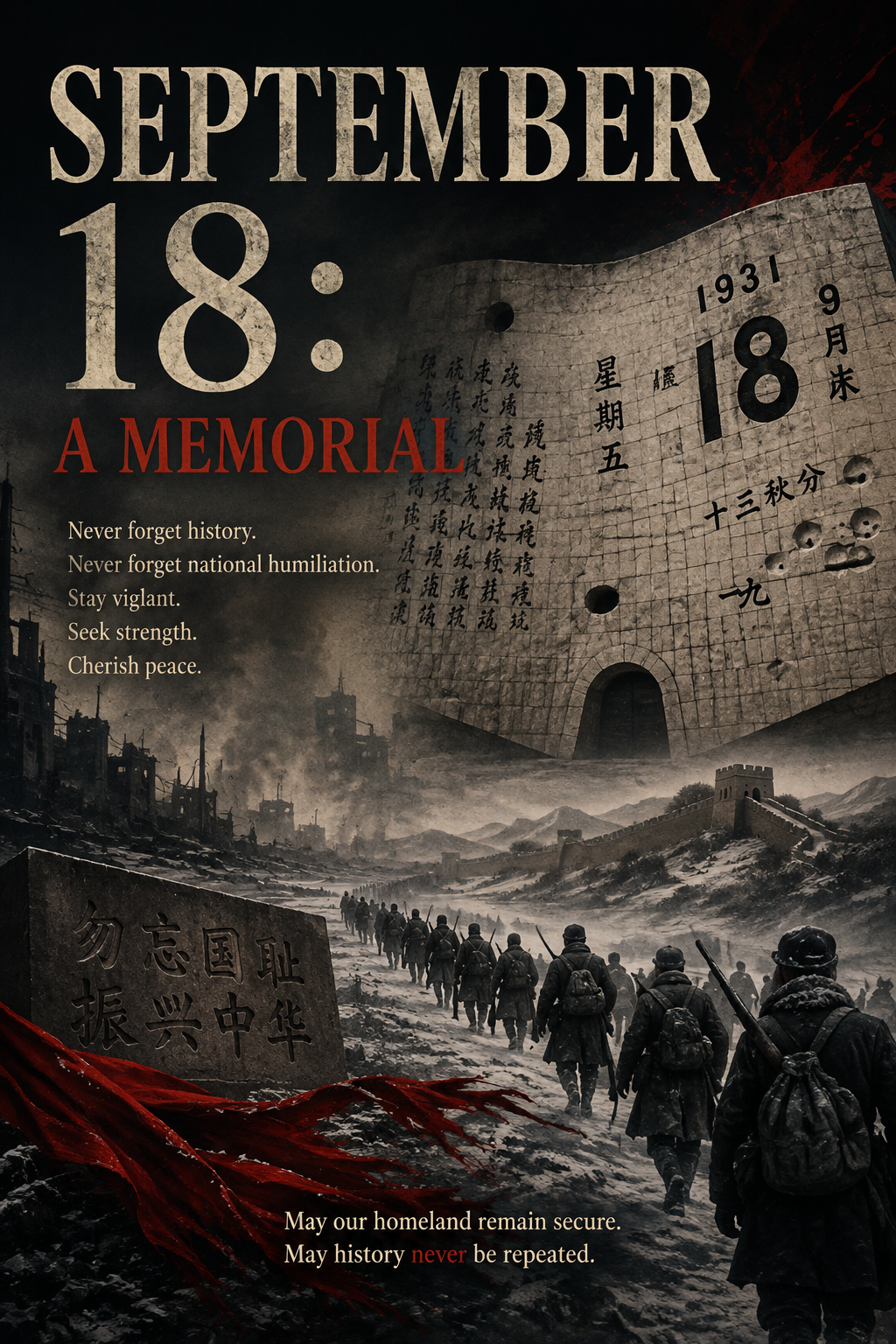
《九一八之祭》
文/泰华
第一章 祭
九一八……
令人心痛的日子……
那是鲜血凝成的大字,
刻在东北父老的心上。
那是熔炉的钢水,
浇入中华儿女的骨髓。
岁月可以远去。
历史不能尘封。
伤口,
尚未愈合。
第二章 沦陷
一九三一年。
在那风雨如磐的年代。
江淮水患。
中原大战。
民不聊生。
水深火热的祖国啊……
苦不堪言。
东洋一隅的狂徒,
蓄谋已久。
趁人之危。
向北大营,
发出了罪恶的炮弹。
羸弱的政府啊……
把希望寄托于,
国联的公正。
放弃抵抗的命令,
将百万平方公里的国土,
拱手让给了,
如狼似虎的禽兽。
几千万东北同胞。
饱受亡国之痛。
侥幸逃离的人们。
流离失所。
一曲《松花江上》,
引多少流浪的人们,
涕泪横流。
第三章 侵略
白山黑水。
大豆高粱。
富庶的东北。
土地被掠走。
安居的百姓,
被蹂躏欺压。
森林。
煤矿。
粮食。
丰饶的物产。
被掠去东洋。
日伪的满洲国。
成了所谓“大东亚共荣”的样板。
“五族协和”的“王道乐土”。
七三一部队的罪行。
令人发指。
奴化的教育。
包藏祸心。
歌舞升平的幻象。
妄想消磨民族的意志。
第四章 抗争
九一八的国耻。
激励不屈的东北子弟。
鞭策同仇敌忾的华夏儿女。
我的骨肉同胞啊,
怎能如羔羊一样任人宰割。
杨靖宇……
周保中……
赵尚志……
李兆麟……
汪亚臣……
陈翰章……
马占山……
赵一曼……
还有,
八女投江的巾帼们……
还有,
许多无名的战士和百姓……
他们,
挺起了民族的脊梁。
他们,
在林海雪原。
在大河沿岸。
在敌后。
在前线。
抗击倭寇。
艰苦卓绝。
“火烤胸前暖,
风吹背后寒。”
“头颅不惜抛掉,
鲜血可以喷洒,
而忠贞不二的意志,
不会动摇。”
第五章 今天
今天……
又逢九一八。
让我们牢记历史。
勿忘国耻。
警钟长鸣。
居安思危。
自强不息。
和平发展。
愿山河永固。
让历史……
不再重演。
English Version 英文版(ChatGPT)
September 18: A Memorial
By Taihua
Part I — Remembrance
September 18…
A day that still aches in the nation’s memory…
Its name was written
not with ink,
but with blood,
etched forever
upon the hearts of the fathers and mothers of Northeast China.
It was molten steel,
poured into the very bones
of the Chinese people.
Years may pass.
History must never be buried.
The wound,
has not yet healed.
Part II — The Fall
The year was 1931.
An age of storms and uncertainty.
Floods swept across the Huai River.
Civil war divided the land.
The people struggled to survive.
China,
already weary and wounded,
endured suffering beyond words.
Then,
from across the eastern sea,
an aggressor,
long prepared,
seized the moment.
Shots rang out
at the Beidaying Barracks,
and the darkness began.
A fragile government…
placed its hopes
in the justice
of the League of Nations.
The decision
to abandon resistance
left more than a million square kilometers of homeland
to the mercy
of ruthless invaders.
Tens of millions
in Northeast China
endured the agony
of a conquered land.
Those who escaped
became refugees.
Homeless.
Scattered.
A single song—
Songhua River—
brought countless wanderers
to tears.
Part III — Occupation
The rivers ran dark.
The fields were rich.
Forests stretched beyond the horizon.
Coal lay deep beneath the earth.
Golden grain filled the plains.
A land blessed with abundance—
its wealth
was carried away
across the sea.
The puppet state of Manchukuo
was hailed
as a model
of the so-called
“Greater East Asia Co-Prosperity.”
“Five Races Under One Union.”
“The Land of Kingly Way.”
Empty slogans,
built upon conquest,
deception,
and fear.
The crimes
of Unit 731
still cry out
against humanity.
Education
became a weapon.
Smiles concealed
hidden schemes.
The illusion
of peace and prosperity
sought to wear away
the spirit of a nation.
Part IV — Resistance
Yet…
the Chinese nation
never surrendered.
The humiliation
of September 18
awakened
the sons and daughters
of the Northeast,
and strengthened
the resolve
of the Chinese people.
My brothers,
my sisters—
how could we
submit
like lambs
awaiting the knife?
Yang Jingyu…
Zhou Baozhong…
Zhao Shangzhi…
Li Zhaolin…
Wang Yachen…
Chen Hanzhang…
Ma Zhanshan…
Zhao Yiman…
The women
of the Eight Maidens
who chose death
over surrender…
And beyond the names
recorded in history,
countless unnamed soldiers,
villagers,
workers,
and families,
who gave everything,
yet asked
for nothing.
Together,
they became
the backbone
of a nation.
Through forests.
Along rivers.
Behind enemy lines.
Upon the front.
They fought,
against impossible odds.
“The fire warmed my chest;
the wind froze my back.”
“I do not fear
the loss of my head.
Let my blood
be shed.
But my unwavering loyalty
shall never be broken.”
Part V — Today
Today…
September 18
returns once more.
Let us remember.
Let us never forget.
May the warning
never fall silent.
Remain vigilant.
Grow stronger.
Cherish peace.
May our mountains
stand forever.
May our homeland
remain secure.
And may history…
never
be repeated.
Terms of Use
You are welcome to share and repost this work, provided that appropriate credit is given to the original creator. Prior written consent from the creator is required for any commercial application.
© 2026 Taihua. All rights reserved. (版权所有,翻版必究)
Instructions on Webpage Language Settings
It is recommended to set your browser’s default webpage language to English. This way, when you visit a Chinese webpage, the page will typically display both the original Chinese text and an English translation derived from the Chinese.
If you need to translate the content further into another language (or convert it into different Chinese characters/fonts), direct translation from Chinese is often inaccurate. In such cases, it is recommended that you refer directly to the English section on the page. Because translation tools generally handle “English-to-other-languages” translation with much higher accuracy, this approach will help ensure better reading comprehension and translation quality.
Choosing this approach to webpage language presentation is a way for our website to go global and provide diverse support. It enables human thought and memory to transcend the barriers of language, space, and time, which is the very purpose of this website.
關於網頁語言設定的說明
建議將瀏覽器的預設網頁語言設定為英文。這樣一來,當您訪問中文網頁時,頁面通常會同時呈現中文原文(簡體/繁體)以及由中文翻譯成的英文版本。
當您需要將網頁內容進一步翻譯成其他語言(或轉換為其他中文簡繁字體)時,由於直接從中文轉譯往往不夠準確,建議您直接參考頁面中的英文部分。因為絕大多數翻譯工具對「英文轉其他語言」的支持更加成熟和準確,這樣能夠有效提升最終的閱讀和理解質量。
選擇這種網頁語言呈現方式,是本網站走向國際、提供多元支持的重要方式。它讓人類的思想與記憶跨越語言、空間乃至時間的障礙,這正是本網站設立的宗旨。
Leave a Reply