作者:泰华
中文版
一、相遇
十几年前,
在加拿大的一座历史博物馆里,
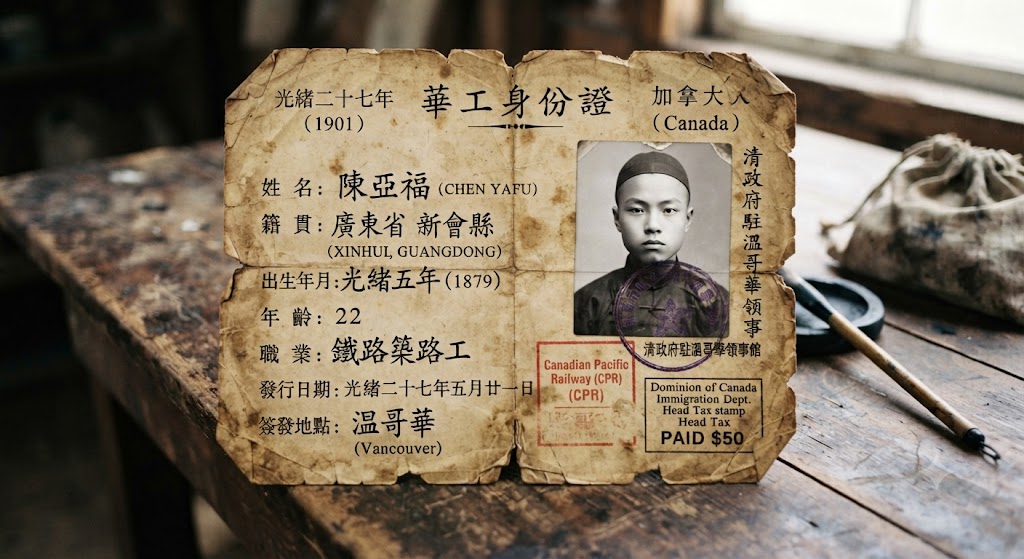
我看到了一张发黄的身份纸。
照片里的你,
面容稚嫩,
分明还是一个少年。
那张似曾相识的脸,
霎时间跨越百年的时空,
在这万里之外的异国他乡,
给了我一种亲人般的感动。
二、远航
我仿佛看见,
你经历了漫长而艰难的海上航行,
来到这个陌生的国度。
耳边,
是听不懂的语言;
眼前,
是陌生的人群。
一切都是那样陌生,
仿佛一夜之间,
走进了另一个世界。
三、异乡
我仿佛看见,
你穿着洗得发白的粗布衣衫,
茫然地开始了新的生活。
新奇,很快过去。
等待你的,
是紧张而艰辛的劳作。
白天,
你单薄的身影,
或出现在淘金热的帐篷里,
或出现在修筑铁路的队伍中。
傍晚,
你拖着沉重的脚步,
回到简陋的工棚。
匆匆吃过自己做的晚餐,
便早早进入梦乡。
四、乡愁
我仿佛看见,
你在梦里,
常常回到大洋彼岸的故乡,
与久违的亲人围坐一处。
从父母含笑的目光里,
你知道,
自己是全家幸福的盼望。
为了这份盼望,
你愿意接受最低廉的工价,
愿意干最苦、最脏的活;
即使冒着生命危险,
也在所不辞。
五、伤痕
我又仿佛看见,
你的坚韧,
你的吃苦耐劳,
换来的却是人头税的屈辱,
和排华法案的不公。
正是这道法案,
让家庭团聚的梦想,
在你心中煎熬了半个世纪。
种族歧视迫使你另谋生路,
开餐馆,
做洗衣房,
成了你无奈的选择。
我又仿佛看见,
每逢国庆日,
你关上店铺,
默默望着街头庆祝的场景,
聆听着远处欢乐的喧嚣。
然而,
这一切,
似乎都与你无关。
排华法案的阴影之下,
别人的欢庆,
只会让你更加黯然神伤,
心如刀绞。
六、等待
我又仿佛看见,
你常常对着镜子,
端详那日渐苍老的容颜,
暗自追问:
难道,
我就这样在异国他乡,
孤苦伶仃地老去吗?
你小心翼翼地拿出一叠翻旧了的家书,
一遍,
又一遍,
重读那些早已背熟的字句。
抬头,
含泪凝视父母的遗像;
低头,
无声翻看妻儿的照片。
盼啊,
望啊,
什么时候,
才是尽头?
遗憾的是,
你终究没能等到,
联邦政府道歉和赔偿的那一天。
七、回响
然而,
时光走到了今天。
作为新一代移民,
我多么想对你说:
前辈啊,
你们太不容易了!
我为你们的痛而痛。
隔着陈列橱窗,
我轻轻抚摸着这张发黄的身份纸。
仿佛,
听见了你的声音:
孩子,
不要忘记过去。
要珍惜来之不易的平等与尊严。
前方还有奋斗。
无论如何,
都要勇敢地面对生活。
啊——
我看见了。
我终于看见了。
你神情里的坚定与盼望,
你目光中的尊严与骄傲。
作者感言
《一张发黄的身份纸》源于我在加拿大一座历史博物馆中的一次驻足。
橱窗里,一张已经发黄的身份纸,静静诉说着一位早期华人移民的人生。那一刻,我忽然觉得,它不仅是一件历史文物,更是一位跨越百年而来的见证者。透过那张年轻而陌生的面孔,我仿佛看见了一代华人在异国他乡艰难奋斗的岁月,也看见了他们在逆境中始终没有放弃的尊严、坚韧与希望。
作为生活在加拿大的新一代移民,我常常想到,今天我们所拥有的平等、尊重与机会,并非理所当然,而是无数前辈用汗水、牺牲与坚持,一点一滴争取而来的。
这篇作品并非为了重述一段苦难的历史,而是希望借一张发黄的身份纸,与一位百年前的华人前辈展开一场跨越时空的对话。记住历史,并不是为了停留在伤痛之中,而是为了珍惜今天,更勇敢地走向未来。
2017年,为庆祝加拿大建国150周年,本作品曾在加拿大四季诗社举办的大型文艺演出《我住渥河之滨》中(石静老师为总导演),首次以剧场演诵节目的形式与观众见面,并获得了现场观众的广泛共鸣与好评。此次重新整理修订,谨以此文向所有为后来者开辟道路的华人先辈致以深深的敬意。
A Yellowed Identity Paper(English Version interpreted by Gemini)
By Tai Hua
I. Encounter More than a decade ago, In a historical museum in Canada, I saw a yellowed identification paper. In the photograph, Your face was tender, Clearly still a youth. That face, which seemed so familiar, Instantly spanned a century of time and space; Here, in this foreign land thousands of miles away, It gave me a sense of moving, family-like affection.
II. The Voyage I could almost see you, Having endured a long and arduous sea voyage, Arriving in this strange country. In your ears, Were languages you could not understand; Before your eyes, Were unfamiliar crowds. Everything was so strange, As if, overnight, You had walked into another world.
III. A Foreign Land I could almost see you, Dressed in faded, rough cloth, Starting a new life in bewilderment. The novelty soon passed. What awaited you Was intense and grueling labor. By day, Your thin figure Appeared either in the tents of the Gold Rush, Or among the ranks building the railroad. By evening, Dragging weary steps, You returned to the humble shanty. After a hasty meal cooked by your own hands, You fell into a deep slumber.
IV. Homesickness I could almost see you, In your dreams, Frequently returning to your homeland across the ocean, Sitting around with long-lost loved ones. From the smiling gazes of your parents, You knew You were the hope of your family’s happiness. For the sake of that hope, You were willing to accept the lowest wages, Willing to do the bitterest, filthiest work; Even facing life-threatening danger, You did not hesitate.
V. Scars I could almost see you again, Your tenacity and hard work Met only with the humiliation of the Head Tax And the injustice of the Chinese Exclusion Act. It was this act That left the dream of family reunion Torturing your heart for half a century. Racial discrimination forced you to seek other ways to survive; Opening restaurants, Running laundries, Became your helpless choices. I could almost see you again, Every National Day, Closing your shop, Silently watching the scenes of celebration on the street, Listening to the joyous clamor in the distance. Yet, All of this Seemed to have nothing to do with you. Under the shadow of the Exclusion Act, The celebrations of others Only made you feel more dejected, Your heart aching as if pierced by a knife.
VI. The Wait I could almost see you again, Often looking into the mirror, Observing your face, day by day growing old, Silently asking yourself: Must I just grow old here, Lonely and destitute in a foreign land? You carefully took out a stack of tattered family letters, Reading again And again, The words you had long ago memorized. Looking up, Gazing through tears at the portraits of your parents; Looking down, Silently flipping through photos of your wife and children. Waiting, and longing— When Would it ever end? Regrettably, You never lived to see The day of the federal government’s apology and redress.
VII. The Echo However, Time has reached today. As a new generation of immigrant, How I wish to say to you: Oh, seniors, You had it so hard! I ache with your pain. Across the display cabinet, I gently touch this yellowed identification paper. As if, I could hear your voice: Child, Do not forget the past. Cherish the hard-won equality and dignity. There is still work ahead. No matter what, Face life with courage. Ah— I see it. I finally see it. The determination and hope in your expression, The dignity and pride in your eyes.
Author’s Note
A Yellowed Identity Paper was inspired by a moment of quiet reflection in a history museum in Canada.
Inside a display case lay a yellowed identity paper, silently telling the story of an early Chinese immigrant. At that moment, I realized that it was more than a historical artifact; it was a witness that had traveled across more than a century. Through the young and unfamiliar face in the photograph, I seemed to glimpse the difficult years endured by generations of Chinese immigrants in a foreign land, as well as the dignity, resilience, and hope they never surrendered, even in adversity.
As a member of a newer generation of immigrants living in Canada, I often reflect on the fact that the equality, respect, and opportunities we enjoy today should never be taken for granted. They were won, little by little, through the hardship, sacrifice, and perseverance of those who came before us.
This work is not intended merely to retell a painful chapter of history. Rather, through a single yellowed identity paper, it seeks to open a conversation across time with a Chinese immigrant from more than a century ago. We remember history not to remain in its sorrow, but to cherish the present and move toward the future with greater courage.
In 2017, to commemorate the 150th anniversary of Canadian Confederation, this work premiered as a featured theatrical recitation at a major cultural performance “By the Banks of the Ottawa River” organized by the Canadian Four Seasons Poetry Society, under the artistic direction of Ms. Jing Shi. The performance received a warm and enthusiastic response from the audience.
Now revised and presented anew, this work is dedicated with profound respect to all the early Chinese immigrants who endured hardship and helped open the way for those who came after them.
2017年演出录像(2017 Performance Recording)
Terms of Use
You are welcome to share and repost this work, provided that appropriate credit is given to the original creator. Prior written consent from the creator is required for any commercial application.
© 2026 Taihua. All rights reserved. (版权所有,翻版必究)
Instructions on Webpage Language Settings
It is recommended to set your browser’s default webpage language to English. This way, when you visit a Chinese webpage, the page will typically display both the original Chinese text and an English translation derived from the Chinese.
If you need to translate the content further into another language (or convert it into different Chinese characters/fonts), direct translation from Chinese is often inaccurate. In such cases, it is recommended that you refer directly to the English section on the page. Because translation tools generally handle “English-to-other-languages” translation with much higher accuracy, this approach will help ensure better reading comprehension and translation quality.
Choosing this approach to webpage language presentation is a way for our website to go global and provide diverse support. It enables human thought and memory to transcend the barriers of language, space, and time, which is the very purpose of this website.
關於網頁語言設定的說明
建議將瀏覽器的預設網頁語言設定為英文。這樣一來,當您訪問中文網頁時,頁面通常會同時呈現中文原文(簡體/繁體)以及由中文翻譯成的英文版本。
當您需要將網頁內容進一步翻譯成其他語言(或轉換為其他中文簡繁字體)時,由於直接從中文轉譯往往不夠準確,建議您直接參考頁面中的英文部分。因為絕大多數翻譯工具對「英文轉其他語言」的支持更加成熟和準確,這樣能夠有效提升最終的閱讀和理解質量。
選擇這種網頁語言呈現方式,是本網站走向國際、提供多元支持的重要方式。它讓人類的思想與記憶跨越語言、空間乃至時間的障礙,這正是本網站設立的宗旨。